
TCFD report
1. Introduction
Task Force on Climate-Related Financial Disclosures
TCFD stands for the Task Force on Climate-Related Financial Disclosures. It is a framework that organisations can use to publicly disclose the climate-related risks and opportunities to their businesses. It was first published in 2017 and updated in 2021.
The Financial Stability Board established the TCFD to develop recommendations for more effective climate-related disclosures that could promote more informed investment, credit, and insurance underwriting decisions and, in turn, enable stakeholders to understand better the concentrations of carbon-related assets in the financial sector and the financial system’s exposures to climate-related risks.
The TCFD concluded its work in 2023, with its recommendations incorporated into the IFRS Sustainability Disclosure Standards issued by the ISSB. Nevertheless, the TCFD framework remains a widely used basis for climate‑related reporting.
Kesko’s strategy and sustainability strategy
Sustainability is a central part of Kesko’s strategy and the business operations of Kesko’s three divisions. We strive to enable more sustainable choices for our customers and drive change throughout the value chain.
The focus areas of our sustainability strategy are climate and nature, value chain, our people, and good governance. Our sustainability work focuses increasingly on the entire value chain.
Kesko and K-retailers together form K Group, which is the biggest trading sector operator in Finland and one of the biggest in Northern Europe. As a major market operator, K Group has a significant role and responsibility in reducing greenhouse gas emissions across its own operations and value chain. We have set both near-term and long-term climate targets, which have been validated by the Science Based Targets initiative (SBTi). Climate targets are described in chapter 5 (Targets and Metrics) of this report.
Kesko’s TCFD framework
As climate change and extreme weather phenomena can impact Kesko’s operations, understanding Kesko’s impact on climate is essential for us. To better address this challenge, we established a working group in spring 2022 to examine climate change related risks and opportunities in Kesko’s grocery trade division in accordance with the TCFD framework and its four thematic areas: governance, strategy, risk management, and metrics and targets. During this work, we recognized ten physical risks and fourteen transition risks, as well as ten opportunities. The most material of these risks and opportunities are described in chapter 3 (Strategy) of this report. Finally, Kesko’s climate risk profile is analysed against different climate scenarios to enable well-justified strategic choices.
Transition from TCFD to ESRS
Earlier, Kesko has aligned its climate‑related disclosures with the recommendations of the Task Force on Climate‑related Financial Disclosures (TCFD), which provided a voluntary, principles‑based framework for disclosing climate‑related risks, opportunities, metrics and targets.
In October 2023, the TCFD was formally disbanded after fulfilling its mandate, and responsibility for advancing and monitoring climate‑related disclosure was transferred to the IFRS Foundation’s International Sustainability Standards Board (ISSB). The ISSB’s climate standard, IFRS S2, builds directly on the TCFD recommendations and incorporates them into a global, standardised disclosure baseline.
Within the European Union, the regulatory approach to climate disclosure has evolved further with the introduction of the Corporate Sustainability Reporting Directive (CSRD) and the European Sustainability Reporting Standards (ESRS). Under CSRD, climate‑related disclosures are no longer voluntary but mandatory for companies within scope. ESRS E1 Climate Change replaces voluntary TCFD‑aligned reporting with legally binding requirements covering climate governance, strategy, transition plans, risk management, metrics and targets. While ESRS E1 retains the TCFD four‑pillar structure, it expands disclosure requirements through a double materiality perspective, requiring companies to report both on climate‑related financial risks and opportunities and on their impacts on the climate and the environment.
Accordingly, Kesko’s climate‑related disclosures have transitioned from voluntary TCFD alignment to mandatory reporting in accordance with ESRS under CSRD.
2. Governance
Board oversight of sustainability and climate-related matters
Kesko’s Board of Directors is responsible for the company’s corporate governance and for the proper organisation of its operations, which also includes responsibility for sustainability topics. According to its charter, the Board reviews and makes decisions on matters that are financially, operationally or fundamentally significant to the Group. The Board of Directors decides on the Group’s strategy, including sustainability topics and strategic targets related to sustainability. Progress made in the strategy and targets is reported regularly to the Board, including as part of the review by the President and CEO.
Management’s role and responsibilities
Kesko’s President and CEO has overall responsibility for the implementation of the sustainability strategy and for achieving the common sustainability objectives. The Group Management Board supports the President and CEO in this role and ensures that sustainability aspects are integrated into management decision-making, strategic planning and operational steering. The Group Management Board regularly discusses Kesko’s most material sustainability impacts, risks and opportunities, as well as progress towards the targets set.
Sustainability management at Group and division level
The Group sustainability management team promotes the measures set out in the sustainability strategy, monitors progress, coordinates Group-level initiatives and shares best practices across Kesko. The team is chaired by the Executive Vice President, Legal and Sustainability, a member of the Group Management Board who reports directly to the President and CEO. The Chair is responsible for the content of the sustainability strategy and for monitoring its progress and supports the implementation of division-specific sustainability strategies.
Division Presidents are responsible for achieving Group-level and division-specific sustainability targets within their respective divisions, monitoring the progress of measures, allocating resources and making the necessary investments.
Sustainability targets in remuneration
Kesko has four share-based commitment and incentive plans: Performance Share Plan President and CEO (PSP President and CEO) and a transitional phase share-based compensation plan (Bridge Plan) for Kesko’s President and CEO, Performance Share Plan (PSP) and Key Personnel Share Plan (KPSP).
One of the performance criteria in the PSP President and CEO, Bridge Plan and PSP is Kesko’s sustainability target with a weight of 10%. The most significant sustainability targets are scope 1 and 2 emission reductions targets and targets linked to international sustainability indices and assessments.
3. Strategy
Most material identified climate-related risks and opportunities
As part of the assessment conducted in 2022 in accordance with the TCFD framework, Kesko has identified one transitional risk as the most material climate-related risk with the potential to have a substantive financial impact on our grocery trade business.
Due to potential increasing regulation, i.e. EU’s revision of the Energy Performance of Buildings Directive (EPBD), large one-time investments in improving energy efficiency of grocery stores may cause increased cash outflows in the long term, provided that the planned regulation comes into effect. Investments in improving energy efficiency decrease energy consumption in grocery stores.
|
Risk event |
Risk description |
|
| Physical |
Changes in temperature leading to increased energy demand and operational costs |
Changes in temperature can lead to increased energy demand and operational costs (e.g., cooling costs). |
|
Long term effects on supply and price for certain commodities globally |
Changing weather events can affect harvest and lead to lower supply and higher price for commodities such as banana, avocado and coffee globally. Additionally, dependence on certain varieties can increase. |
|
|
Heat waves causing malfunctions to electric appliances |
Climate change will increase heat waves and this can negatively affect for example cooling appliances. Potential malfunctions can lead to higher costs as well as loss of inventory. |
|
|
Extreme weather events leading to electricity blackouts |
Extreme weather events such as floods and storms can lead to electricity blackouts and malfunction of appliances that affect inventory. |
|
|
Floods, snow, heavy rain causing damage to buildings |
Snow and rain can cause damage to buildings - for instance, heavy rain and floods can overwhelm the sewer lines and snow pressure on the roofs create a hazard. |
|
| Transitional |
Investment decisions in the carbon neutral heating |
Low carbon heating solutions will require significant investments, causing potential technology risks in the new technologies. Limited availability of green district and geothermal heating, and higher prices. |
|
Large one-time investments in properties |
Investments related to e.g., properties with long life cycle and uncertainty in choosing the right technology to invest in. |
|
|
Climate-related litigation |
Increased exposure to climate-related litigation due to increasing regulation and impact of climate change. |
|
|
Value chain due diligence |
Potential EU and national Due diligence regulation extending to the entire value chain. This will extend Kesko’s responsibility/liability in its value chain and require improved transparency and processes to manage and mitigate potential supply chain risks. |
|
|
Higher fuel and energy prices |
Green transition will require a shift towards new energy sources and fuels. Price of fossil fuels will rise due to emission pricing and still limited availability of renewable energy sources. Higher fuel and energy prices can lead to increased operational costs. |
Climate change is also creating opportunities for Kesko’s business while the society undergoes a transition and the demand for low-carbon products and services increases. The main driver of identified business opportunities is the changing customer behaviour – for instance, Kesko’s own climate performance can lead to better competitive position reflecting shifting consumer preferences and increased engagement within the client base. Kesko will face new opportunities to export low-carbon and climate resilient domestic products to new markets as well as by launching new low-carbon brand and expanding the plant-based product selection.
Scenario analysis
In the assessment conducted in 2022 in accordance with the TCFD framework, the focus of climate-related risk and opportunity analysis was on grocery trade. The materiality of each identified climate risk and opportunity was first assessed against the baseline scenario, after which Kesko’s operations were analysed against two additional scenarios with strongly declining emissions (scenario 2) and stabilizing emissions (scenario 3) to understand how different future outcomes may impact the grocery trade business. The three adopted scenarios are described below:
1. A baseline scenario
This baseline scenario is built around an assumption that announced global climate strategies and targets are expected to be delivered. This would lead globally to temperature increase of 2.5 to 3 °C from pre-industrial level, which may lead to over 4 °C warming in Finland.
2. Scenario with strongly declining emissions (IPCC RCP 2.6)
This scenario presents a world with strong global climate ambitions and actions, leading to the average temperature increase of 1.5 to 2 °C from pre-industrial baseline, expected to limit the warming to 3 °C in Finland.
3. Scenario with stabilizing emissions (IPCC RCP 6.0)
This scenario presents a world with lacking global climate ambitions and actions, leading to the average temperature increase of 3 to 3.5 °C from pre-industrial baseline, which could mean close to 5 °C warming in Finland.
For transition risks, the analysis is building on applicable transition scenarios by the International Energy Agency (IEA SDS, IEA NZE and IEA STEPS).
The selection of scenarios assumes that the most extreme future projections involving a large-scale increase in coal use or, on the contrary, achieving the 1.5°C target by immediate and drastic emissions reductions are becoming less likely to come to fruition. It is to be noted that even a seemingly slight temperature rise may come with a significant increase in associated adverse impacts on the ecosystems and society. The scenarios presented all involve a distinctive set of key factors while they are found plausible future projections in the context of the latest climate science.
The key findings of the Scenario 2 (strongly declining emissions) analysis are:
Risks: In Scenario 2, the transition risks increase greatly due to implementation of more ambitious policies, rapid technological development and increased stakeholder pressure to apply low carbon solutions. In particular, requirements for value chain due diligence and the related reputational risks are expected to expand due to the rise in climate policy ambition and increased consumer awareness. Additionally, in Scenario 2, transition to innovative low-carbon technologies accelerates and may cause potential technology risks associated with investments in novel technologies. For example, significant investments are needed in carbon neutral heating solutions.
The scale of materialized risks is dependent on the scenario pathway meaning that a disorderly transition involving unexpected changes in policies would entail higher risks to the retail business.
Opportunities: In Scenario 2, changing consumer preferences and behavior increasingly affect the retail business. The Scenario is more attractive for Kesko with a sustainable profile and brings new business opportunities, including, for example, development of new product lines, expanding plant-based product selection, as well attracting sustainable financing with reduced cost of capital.
The key findings of the Scenario 3 (stabilizing emissions) analysis are:
Risks: In Scenario 3, physical climate risks, including extreme weather events, can have potential impacts to Kesko’s business and value chain, especially over the longer term as the actions to stop climate change are insufficient causing accelerating climate crisis. The changing climate can lead to a major change in food production areas globally, causing disruptions in the availability of certain commodities and significant price increase. Global supply chains and logistic routes may face notable changes, affecting Kesko’s business.
In Finland, climate change will lead to e.g. in intense storms with heavy wind, rain, and flash floods as well as prolonged heat spells in the summertime. Climate change physical risks can directly affect infrastructure, including properties and other assets, as well as logistics. Changes in temperature can lead to increased energy demand and operational costs. In addition, extreme weather events can affect agriculture and harvest in Finland, causing disruptions in the supply chains.
Opportunities: In Scenario 3, sustainability and climate are not the major drivers of consumer behaviour and preferences, decreasing business opportunities related to expanding product offering and supporting sustainable consumer choices. In this scenario, climate crisis can cause significant disruptions on the global value chains. Local production in Finland and building resiliency in the local value chains can improve climate resiliency. New export opportunities may rise in the global market, which is increasingly affected by the physical risks of the climate crisis.
4. Climate risks in Kesko’s risk management process
Overall risk management approach
Risk management at Kesko is proactive and an integral part of day-to-day management to assess and manage business-related opportunities and risks. Kesko’s divisions and common operations are responsible for identifying, assessing, handling and managing risks related to their operations, and they report on risks, risk management responses and the results of those responses to the risk management function.
Members of the Group Management Board are responsible for the effective and efficient implementation of internal control and risk management in their respective areas of responsibility. A risk management function independent of businesses is responsible for providing a framework and guidance for internal control and risk management, and it supports, coordinates and supervises risk management implementation in Kesko Group.
Roles and reporting in risk management
The Risk Management Steering Group headed by the Chief Financial Officer is responsible for establishing the Group’s overview of the risk situation. The President and CEO is responsible for the effectiveness and efficiency of the Group’s risk management, and approves Group risk reports before they are reviewed by the Board of Directors.
Kesko’s Board of Directors monitors and assesses the effectiveness of risk management and supervises the assessment of risks related to the company’s strategy and operations and their management, supported by the Audit Committee. The Group’s most significant risks and uncertainties, as well as material changes in and management responses to them, including indicators, are reported to Kesko Board’s Audit Committee quarterly in connection with the review of interim reports, the half-year financial report and the financial statements.
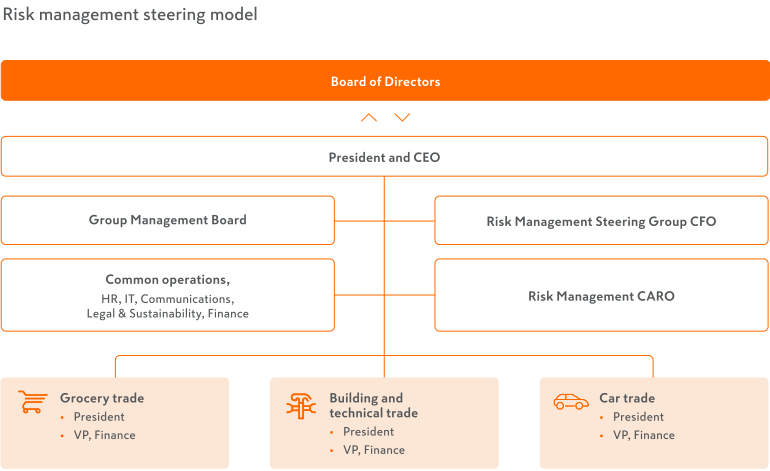
Picture 1. Risk management steering model.
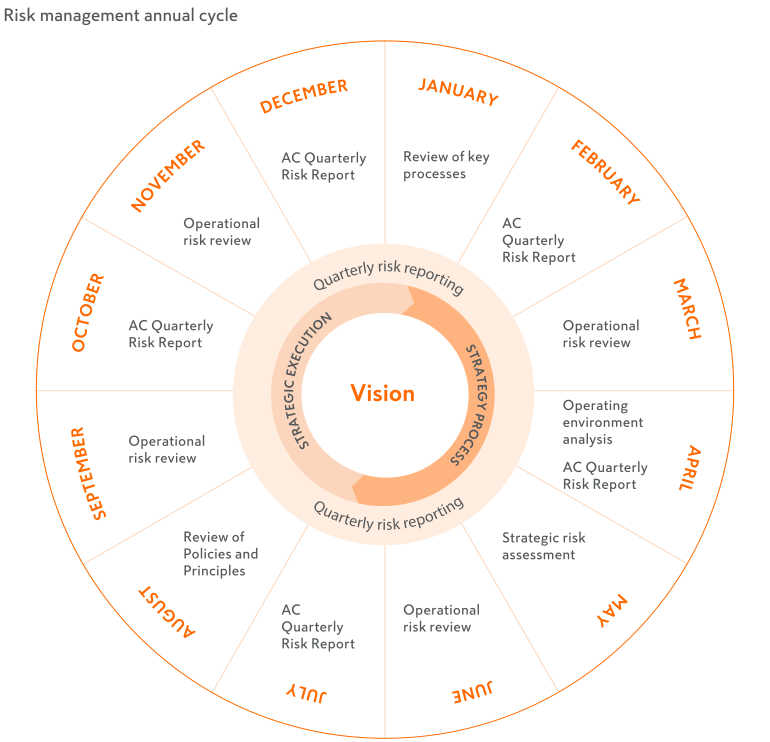
Picture 2. Risk management annual cycle.
Integration of sustainability-related risks into risk management
Risks and opportunities related to sustainability are assessed annually in accordance with the ESRS, and they are consolidated into the Group’s sustainability risk report.
5. Targets and metrics
Kesko has established science‑based greenhouse gas (GHG) emissions reduction targets to manage climate‑related risks and opportunities across its operations and value chain. These targets form a core element of Kesko’s climate strategy and support resilience under the transition to a low‑carbon economy.
Description of targets and scope
Kesko’s emissions reduction targets cover scope 1, 2 and material scope 3 emissions, including emissions from purchased goods and services and the use of sold products. Where emissions related to forest, land and agriculture are material, Kesko has also set specific FLAG (Forest, Land and Agriculture) targets in line with the Science Based Targets initiative (SBTi) requirements.
Kesko commits to the following emissions targets:
- Near‑term targets
- Reducing absolute scope 1 and 2 GHG emissions by 58.8% by 2034 from a 2024 base year.*
- Reducing absolute scope 3 GHG emissions from purchased goods and services and use of sold products by 35.0% within the same timeframe.*
- Reducing absolute scope 1 FLAG GHG emissions by 42.4% by 2034 from a 2024 base year.**
- Reducing absolute scope 3 FLAG GHG emissions by 42.4% within the same timeframe.**
- No deforestation across Kesko Corporation's primary deforestation-linked commodities, with a target date of December 31, 2025.
- Long‑term targets
- Reducing absolute scope 1, 2 and 3 GHG emissions by 90.0% by 2050 from a 2024 base year.*
- Reducing absolute scope 1 and 3 FLAG GHG emissions by 72.0% by 2050 from a 2024 base year.**
- Net‑zero target
- Achieving net-zero greenhouse gas emissions across the value chain by 2050.
*The target boundary includes land-related emissions and removals from biogenic feedstocks.
**The target includes FLAG emissions and removals.
In addition to its emissions targets, Kesko’s energy strategy aims to improve energy efficiency by 10% between 2024 and 2030.
Validation and ambition
Kesko’s near‑term, long‑term and net‑zero emissions reduction targets have been validated by the Science Based Targets initiative (SBTi). The targets are aligned with the Paris Agreement objective of limiting global temperature increase to 1.5°C and cover emissions across Kesko’s entire value chain.
Metrics and methodologies
Progress toward the emissions reduction targets is measured using absolute greenhouse gas emissions (tCO₂e) by scope, calculated in accordance with the GHG Protocol. Kesko tracks emissions from its own operations (scope 1 and 2) as well as material Sscope 3 categories, including FLAG emissions where applicable.
Changes in emissions performance are monitored annually, and calculation methodologies are updated as needed to reflect improved data quality or methodological developments, ensuring consistency and transparency over time.
Performance monitoring and key levers
Targets are supported by concrete operational and value‑chain measures. In Kesko’s own operations, the most significant sources of scope 1 and 2 emissions are fuel use in transportation, logistics and company cars, and the use of district heat. Key emissions reduction measures include electrification of transport, increased use of renewable energy and biofuels, energy efficiency improvements, and waste heat recovery solutions in stores.
As the majority of Kesko’s emissions arise in the production and use of sold products, progress toward scope 3 targets depend significantly on supplier engagement and collaboration to reduce emissions throughout the value chain.


