

Investor blogs and podcasts
In Kesko’s investor blogs and podcasts, Kesko’s management discusses topical issues relevant to investors and shareholders.
Recap of Kesko’s key events in Q3/2026
Kesko will publish its Q3 interim report on Thursday, 29 October 2026, at around 8.00 am Finnish time. An English-language audiocast / teleconference for investors and analysts will be held at 9.00 am Finnish time.
Below you'll find a recap of key news and events in the third quarter.
NEWS, FINANCIALS AND SHARES
-
Kesko receives unconditional approval from the European Commission for the acquisition of Dahl operations in Sweden and Brødrene Dahl operations in Norway and Denmark. (release)
-
Visit also our dedicated website for the Dahl acquisition.
-
The composition of Kesko’s Shareholders' Nomination Committee. (release)
-
Shares: Realisation of Kesko's share-based commitment and incentive plan KPSP 2024. (release)
-
The presentation for Kesko’s investor meetings in Q3. (presentation)
SALES DEVELOPMENT
Sales figures for September will be released in mid-October.
GROCERY TRADE
-
The grocery trade division took steps to make digital shopping easier. The Scan & Buy service – in which grocery shoppers can scan the products they buy using the K-Ruoka mobile app as they move around the store and pay the final total on their way out – expanded to include 60 stores. The K-Plussa loyalty card can now be added to Apple Wallet, and going forward, loyalty customers may choose to be fully digital, with no physical loyalty card, which can save up to 1,000 kilograms of plastic per year. (news in Finnish: Scan & Buy and Apple Wallet)
BUILDING AND TECHNICAL TRADE
-
Why does Kesko see growth potential in technical trade? Kesko is increasing its footprint in technical trade in the Nordic countries. We see plenty of growth potential, driven by megatrends such as the growing need for renovation building and infrastructure renewal, the green transition and tightening regulation, and the growing technological sophistication of buildings and construction. We examine these growth drivers in more detail in our IR blog. (blog post)
Technical trade in the Nordic countries offers strong potential for growth
Building and technical trade is Kesko’s second-largest division. It comprises building and home improvement trade and technical trade, each accounting for approximately half of the division’s net sales.
Kesko first expanded its operations into technical trade in 2016 when it acquired the established Finnish sector operator Onninen. As part of Kesko, Onninen’s net sales have grown by some 56% and operating profit by some 232% (2015 figures vs. 2025). Today, Kesko operates in technical trade via Onninen in seven countries: Finland, Sweden, Norway, Poland, Estonia, Latvia and Lithuania. In June 2026, Kesko announced an agreement to strengthen its technical trade business in the Nordics by acquiring Dahl companies in Sweden, Norway and Denmark.
Technical trade is fully B2B-focused wholesale of products and services related to building services engineering, industry, infrastructure and energy solutions. Kesko’s technical trade market can broadly be divided into two main segments: HVAC products, comprising solutions for heating, water, sewage, ventilation and cooling; and electrical products, which includes products and solutions for electrical installation, power generation, automation and electrical infrastructure. The customer base for technical trade comprises technical contractors, industry and infrastructure operators, and product retailers.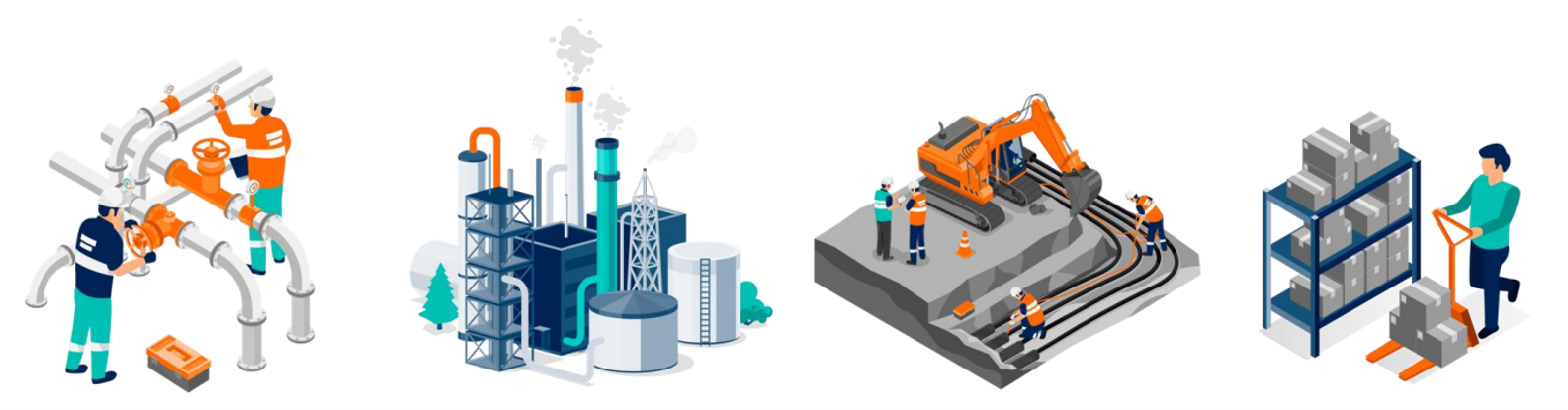
Customers for technical trade include technical contractors, industry and infrastructure operators, and product retailers
Technical trade growth drivers in the Nordic countries
Kesko sees significant growth potential in technical trade in the stable and affluent Nordic markets. Growth in technical trade is supported by various megatrends, including increasing demand for renovation building and infrastructure renewal, the green transition and tightening regulations, as well as the growing technological sophistication of buildings and construction.
Renovation building and infrastructure renewal

The need to renovate and modernise buildings as well as transport, energy, water and telecom networks supports demand for technical trade in the Nordic countries. Key drivers include the ageing of built environment, the electrification of all aspects of life, growing energy-efficiency requirements, and digitalisation. According to PwC, infrastructure investments in the Nordic countries are expected to be almost 80% higher between 2025 and 2050 than during the preceding 20-year period
Maintenance backlogs have grown particularly in transport infrastructure. In Finland, the maintenance backlog of the transport network is estimated to total almost €4.3 billion, of which around €2.6 billion relates to roads and €1.6 billion to railways. Sweden has approved a national road and rail programme worth over €100 billion for 2026–2037, while Norway’s National Transport Plan (NTP 2025–2036) allocates approximately €110 billion to transport infrastructure. Denmark has earmarked around €21 billion for transport infrastructure investments through 2035. Upgrading transport networks increases demand for products such as pipes and cables, lighting and traffic management systems, steel and concrete products used in bridges and tunnels, and civil engineering supplies.
The electrification of society and the growing share of renewable energy require substantial investment in electricity grids. According to the European Commission, electricity consumption in the EU is expected to increase by around 60% by 2030, while 40% of the distribution networks are over 40 years old. Consequently, investments of €584 billion in electricity grids are estimated to be required across the EU by the end of the decade. Meanwhile, Norway’s transmission system operator Statnett plans to invest some €13–17 billion in the transmission grid and its digitalisation over the next ten years. Building energy systems are also being extensively upgraded: buildings account for around 40% of the EU’s energy consumption, and the EU’s Renovation Wave strategy aims to renovate 35 million buildings by 2030 and at least double the annual rate of energy renovations. This is increasing demand for electrical switchboards and accessories, cabling, substations, heat pumps, heat recovery systems for ventilation, insulation and window products.
Ageing water supply and sewerage networks also require substantial investments in maintenance and renewal. Tightening environmental requirements, advances in water treatment technology, stormwater management needs and climate adaptation measures increase the need for investments. In Finland, investment needs related to ageing pipelines have been estimated to total more than €10 billion over the next 20 years. In Sweden, investment needs in water and wastewater infrastructure through 2040 have been estimated to amount to as much as €50 billion, while corresponding investment needs in Norway are estimated at approximately €35–46 billion between 2025 and 2045. Modernising water infrastructure increases demand for water and sewer pipes, pumping stations, valves and fittings, stormwater systems, and automation solutions for water treatment and network monitoring.
The growth of artificial intelligence, cloud services and the data economy is accelerating investments in digital and telecommunications infrastructure, such as fibre networks, 5G connectivity, and data centres. According to an EU estimate, the rollout of gigabit and 5G networks alone will require more than €148 billion of investment across Europe by 2030. The Nordic countries have emerged as one of Europe’s fastest-growing regions for data centres thanks to relatively low-cost renewable electricity, a cool climate, and a stable operating environment. Across Europe, data centre investments are expected to exceed €175 billion during 2026–2031. In Finland, identified data centre investments are estimated to total approximately €12 billion between 2025 and 2030. The annual Nordic market for data centre construction is expected to grow from approximately €3.5 billion in 2025 to nearly €12 billion by 2031. These projects create demand for fibre and data cabling, cable trays and installation supplies, power supply and UPS solutions, as well as cooling and ventilation systems for the data centres.
Ageing building stock is increasing demand for property renovation. In Finland, for example, the annual technical renovation need for residential buildings is estimated at almost €8 billion during 2022–2050, and the need is expected to continue growing as the building stock ages further.
Green transition and tightening regulations

The green transition and the EU Fit for 55 climate package are also boosting demand for technical trade products. The Energy Performance of Buildings Directive (EPBD) requires the phased installation of solar power systems in new and large existing buildings between 2027 and 2030, increasing demand for solar power systems and electrical products.
The electrification of transport, supported by the Alternative Fuels Infrastructure Regulation (AFIR), which requires the deployment of a comprehensive public charging network, is increasing demand for charging infrastructure, cabling, and electrical products both in buildings and public networks. The gradual introduction of mandatory environmental criteria in procurement favours suppliers that are able to offer low-emission products with documented environmental performance.
The new ETS 2 emissions trading system covering building heating, together with the Social Climate Fund worth over €86 billion, is expected to further improve the attractiveness of heat pumps and low-emission building services solutions. In the Nordic countries, this is likely to be reflected primarily in replacement and efficiency-improvement demand, as well as the replacement of remaining fossil-fuel-based heating systems. This supports sales of air-to-water and ground-source heat pumps, hybrid systems and related storage tanks and control solutions.
Increasing technological sophistication, innovation and digitalisation in buildings and construction

Buildings are becoming increasingly technologically sophisticated as energy efficiency, automation and smart building technologies continue to advance. User expectations are also rising, particularly in residential buildings. The Nordic construction sector is among the most digitally advanced in the world, and the Nordic building and automation control (BACS) market is expected to grow at around 6% annually over the next decade. Technical trade companies will increasingly provide product expertise, design solutions and value-added services to support their customers’ business.
Megatrends support growth in technical trade
The technical trade market in Kesko’s operating countries has been challenging in recent years due to lower construction volumes. Despite the market conditions, Onninen has managed to deliver good results, underpinned by, among other things, good product availability, operational efficiency, investments, and advanced digital capabilities.
In 2026, technical trade has grown in all of Kesko’s current operating countries, and the growth is expected to continue. While markets in Finland and Norway remain subdued, they have improved compared with previous years. In Sweden, Poland and the Baltic countries, markets are gradually normalising. Long-term megatrends support market growth, and once the Dahl acquisition is completed, Kesko’s position in Northern European technical trade will be even stronger.
President and CEO Rauhala: Profit improved significantly in Q2, with technical trade as a driver
"Kesko’s net sales grew in all divisions and profit improved in the second quarter of the year. The net sales totalled €3,379 million, up by 4.2% year-on-year in comparative terms. Profit growth was the strongest in the building and technical trade division, thanks in particular to good sales and profit performance in technical trade. The Q2 comparable operating profit totalled €194 million, representing an increase of €17.3 million. Cash flow from operating activities also strengthened.
In the grocery trade division, net sales grew and totalled €1,621 million, with a comparable operating profit of €110.6 million. The comparable operating profit decreased slightly by €0.7 million, as Kespro’s profit weakened by €2.2 million due to a challenging market. Kespro’s sales decreased by 0.6%, but still outperformed the market. K Group’s grocery sales increased by 4.3%, while the total grocery market grew by approximately 2% (Kesko's estimate, based on market figures by the Finnish Grocery Trade Association PTY). All our grocery store chains gained market share in their respective size segments in both Q2 and H1. Market share growth was the strongest in our K-Supermarket chain, which operates in the largest segment in Finnish grocery trade, i.e. supermarkets. K-Citymarket’s non-food sales grew by 4.4% and our market share in non-food increased. The long-term strategic investments we have made in our store quality, prices and network are yielding results.
In the building and technical trade division, net sales grew by 14.3% and totalled €1,413 million. The Q2 comparable operating profit grew by €20.3 million and totalled €71.2 million. Sales and profit grew particularly strongly in technical trade. Onninen Finland gained market share notably in the second quarter, but technical trade sales grew also in our other operating countries. Net sales for building and home improvement trade increased by 13.7% supported by acquisitions, and by 6.2% in comparative terms. B2B sales outperformed B2C sales in building and home improvement trade. Net sales grew in all operating countries in both technical trade and building and home improvement trade. The €5.4 million share of result from the joint venture Kesko Senukai also supported the division’s profitability. The gradual recovery in the construction cycle continued in all our operating countries. Market demand has picked up in, for example, industrial projects and infrastructure construction, but has remained muted in new housing construction.
In the car trade division, net sales totalled €353 million, up by €1 million. Net sales growth was driven in particular by used car sales, and service sales were also up. The comparable operating profit of €18.4 million represents a decrease of €3.2 million. The order book for new cars has grown by some 40% both year-on-year and since the beginning of this year. The order book is set to translate into sales during the latter half of the year. In sports trade, sales increased and profit was at last year’s level.
We announced the biggest acquisition in Kesko’s history in June: we are set to strengthen our technical trade operations by acquiring Dahl’s businesses in Sweden, Norway and Denmark from Saint-Gobain. The combined net sales of the businesses to be acquired totalled nearly €2.1 billion in 2025. Technical trade offers significant growth potential in the stable and affluent Nordic markets as construction becomes increasingly technical and infrastructure construction and renovation building continue to grow. The debt-free transaction price of €1.2 billion will initially be covered using bridge financing. Decisions regarding the final capital structure have not yet been made, and details are estimated to be determined during Q3. Competition authorities have begun their process, and the acquisition is expected to be finalised by the beginning of 2027.
We are updating our profit guidance, and now estimate that Kesko’s comparable operating profit for 2026 will amount to €670–730 million, while our previous estimate was €650–750 million. We estimate that Kesko’s operating environment, net sales, and profit will improve in all divisions and operating countries this year."
KEY FIGURES IN APRIL-JUNE 2026:
-
Group net sales in April–June totalled €3,379.1 million (€3,188.8 million); reported net sales grew by 6.0% while in comparable terms, net sales grew by 4.2%
-
Comparable operating profit totalled €194.0 million (€176.7 million), representing an increase of €17.3 million
-
Operating profit totalled €191.0 million (€177.9 million)
-
Cash flow from operating activities totalled €362.1 million (€323.9 million)
-
Comparable earnings per share €0.32 (€0.29); reported earnings per share €0.32 (€0.29)
> See the Q2/2026 interim report and presentation materials
Recap of Kesko’s key events in Q2/2026
Kesko will publish its half-year financial report for 2026 on Wednesday, 22 July 2026, at around 8.00 am Finnish time. An English-language audiocast/teleconference for investors and analysts will be held at 9.00 am Finnish time and can be accessed here.
Below you'll find a recap of key news and events in the second quarter.
NEWS, FINANCIALS AND SHARES
-
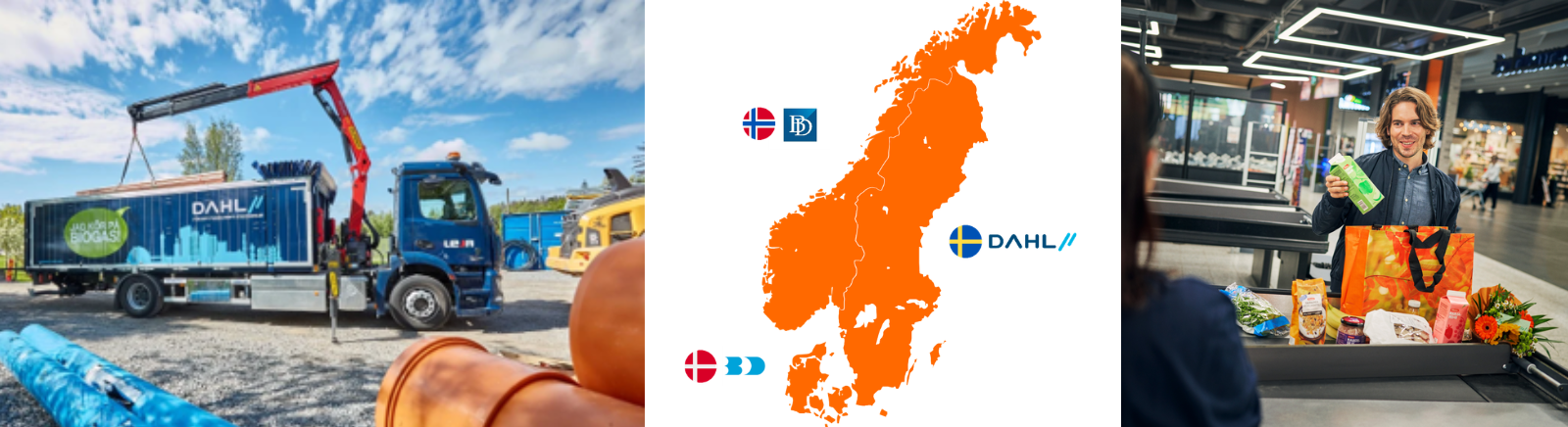
Kesko announced it will acquire the technical trade operator Dahl’s companies in Sweden, Norway and Denmark. The combined net sales of the companies to be acquired totalled nearly €2.1 billion in 2025. The largest transaction in Kesko’s history is set to expand Kesko’s reach in the HPAC and infrastructure construction businesses in Sweden, Norway and Denmark. The debt-free transaction price is €1,200 million excluding lease commitments (€1,518 million including lease commitments). The completion of the acquisition is subject to approval by competition authorities and is expected to take place by the start of 2027.
-
Shares:
-
Change in the holding of treasury shares (release 17 April)
-
Change in the holding of treasury shares. (release 30 April)
-
-
Presentation for Kesko’s investor roadshow meetings in Q2. (presentation)
SALES DEVELOPMENT
Sales figures for June will be released in mid-July.
GROCERY TRADE
-
K Group grocery stores gained market share every month between October last year and March 2026, and the positive momentum has continued. The gains in market share can be attributed to strategic investments made quality, prices and store network development, but they have not come at the expense of profitability. (investor blog post)
SUSTAINABILITY
-
Kesko was again included in the Dow Jones Best-in-Class World and Dow Jones Best-in-Class Europe sustainability indices (DJ BIC). Kesko was among the top five companies in its industry to be included in the DJ BIC World, receiving strong scores for e.g. Transparency & Reporting, Biodiversity, Water, Climate Strategy, and Human Rights. (release)
-
Kesko’s sustainability work in action. Sustainability work at Kesko is carried out across all divisions in various ways. Our investor blog post highlights recent progress made and plans under each the themes of Kesko’s sustainability strategy. (blog post)
Questions and answers about the Dahl acquisition
Kesko announced on Monday, 15 June 2026 that it has agreed to acquire the companies of leading Nordic technical trade operator Dahl in Sweden, Norway and Denmark. Below you will find some questions and answers concerning the transaction.
FINANCIAL FIGURES AND IMPACT
What is the operating profit for the companies to be acquired?
-
We and the seller have agreed not to disclose operating profit figures for the companies to be acquired. All three companies are profitable, with the biggest one in Sweden being the most profitable.
How does Dahl’s operating margin compare to that of Kesko’s building and technical trade division? Dahl’s EBITDA of 7.1% is close to that of Kesko’s building and technical trade – how do you intend to increase value when the EBITDAs already align?
-
We have agreed with the seller that operating profit figures for the acquired businesses will not be disclosed.
-
When comparing the figures for Kesko and Dahl, it is worth noting that the figures for Kesko’s building and technical trade division also include building and home improvement trade. In technical trade, profitability is supported by a business model that relies less on, for example, the store network and more on high volumes, automated central warehouses and digital sales.
-
Dahl represents technical trade, just like Onninen in Kesko. In 2025, the operating margin for Kesko’s technical trade was 3.9% and in 2024 it was 4.0%, while the figures for building and home improvement trade were 3.0% (2025) and 2.7 % (2024). In Finland, Onninen’s operating margin was 5.1% in 2025 and 6.1% in 2024.
-
Dahl is 100% technical trade, and its business is based on automated central warehouses, with a high share of digital sales. Dahl’s digital sales account for around 35% of sales and Onninen’s for 39%.
Why does Kesko pursue this deal at a higher multiple than prior acquisitions?
-
This is a very rare opportunity. Dahl is in the heart of our growth strategy for building and technical trade. It is a leading technical trade distributor in HPAC in the Nordics and from Kesko’s perspective the strategic fit is extraordinary.
-
Valuation-wise we have considered Dahl’s long-term performance over the current low cycle and also future potential with strong market positions in the growing technical trade market. There’s also meaningful upside from operational perspective. On this basis, the deal is strategically compelling and financially accretive longer term.
What is the expected impact of the acquisition on earnings per share (EPS)?
-
The impact on EPS will depend on the final structure of the long-term financing package. At this stage, the company does not intend to provide specific guidance on the immediate EPS impact of the transaction. Over the medium to long-term, however, the acquisition is expected to be EPS accretive, supported by disciplined strategy execution, as well as increased scale and market position.
Will the acquisition impact Kesko’s dividends?
-
It will not, Kesko's dividend policy aims to distribute a dividend of some 60-100% of its comparable earnings per share, taking into account the company’s financial position and strategy.
What is the interest rate for financing the acquisition?
-
In the bridge financing, the rate is close to Kesko’s current level. The interest for future refinancing depends also on market conditions, but our aim is to keep it at the same level as it would be without this kind of deal. At the moment, we are at 3.3 -3.5 % on average in this type of financing.
How will the equity component be raised and when?
-
The plan is for the equity component of the financing to be implemented through a share issue estimated at approximately €500–700 million. No decision has been made regarding the form of the equity issue, while the timing will be subject to securing the acquisition and market conditions.
-
Kesko will assess financing alternatives at the later stage taking into account balance sheet considerations, market conditions and the interest of its shareholders.
-
Kesko’s Board of Directors, or the General Meeting if necessary, will make a separate decision regarding the details of the issue at a later date. The Board has been authorised by Geneal Meeting to decide on the issuance of a maximum of 33,000,000 Kesko B shares.
DAHL AND ITS IMPACT ON KESKO’S OPERATIONS
How many stores does Dahl have in Sweden, Norway and Denmark?
-
There are nearly 190 stores in total: 80 in Sweden, 54 in Norway and 53 in Denmark.
How has Dahl’s Nordic business developed this year versus 2025? Can you see signs of the market cycle turning
-
We cannot disclose Dahl’s latest figures, but overall we can see that the market is gradually improving. New residential starts are still at the lower level, but we see that activity is going the right direction. It is worth noting that renovation building accounts for approximately half of Dahl’s sales, and the stable infrastructure construction business accounts for approximately one-third. We see a lot of opportunities in these businesses.
What kinds of synergies do you expect to obtain?
-
We expect to see synergies in purchasing and own brand products, as well as in IT, for example. This is primarily a strategic acquisition, and synergies are not the main driver.
-
In HPAC products, our sales volumes will close to triple from one €1 billion nearly €3 billion.
-
We will leverage synergies between Dahl and Kesko businesses in different countries to drive, for example, a higher share in private labels. Dahl is already well managed – our priorities are to retain the heritage and customer relationships. This is not a headcount-reduction or cost-slashing case.
What will be Kesko’s market position and market shares following the acquisition?
-
We are already the market leader in Finland with a market share of over 40%. Following the acquisition, we would be the market leader in Norway as well, with market share of some 40%, and #3 on the market in Sweden and Denmark, with market shares of 20% and below 20%, respectively.
The acquisition includes three central warehouses – are you anticipating investment needs related to those facilities?
-
We do not anticipate any immediate investment needs: the warehouse in Sweden is only a couple of years old, and the facilities in Norway and Sweden have been updated and have a high level of automation.
Do the lease agreements of the companies to be acquired differ in length from those on Kesko’s building and technical trade?
-
The lease agreements are aligned with those of Kesko.
-
What will happen to Dahl’s operations in Finland and the Baltics?
-
Kesko acquires Dahl businesses in Sweden, Norway and Denmark – we cannot comment on other operations on behalf of the seller. Kesko already has a strong market position in Finland and the Baltics.
How will the acquisition and building and technical trade becoming Kesko’s biggest division in terms of sales impact the grocery trade division and the car trade division?
-
The acquisition will not impact Kesko’s grocery trade and car trade divisions, which have their own effective strategies that we will continue to execute.
Kesko’s everyday sustainability work yields tangible results
Sustainability work at Kesko is carried out across all divisions in various ways. Our sustainability strategy focuses on the following key themes: climate and nature, value chain, our people, and good governance. In this blog post, we highlight recent progress and plans under each of these themes.

Theme: climate and nature
Reducing emissions
A key priority in our sustainability strategy is advancing Kesko’s emission targets. In January 2026, the international Science Based Targets initiative (SBTi) validated Kesko’s new near-term and long-term science-based emission reduction targets.
“We have a plan extending to 2034 to reduce emissions from our own operations, and we are proceeding according to the plan. Key measures include electrifying logistics and switching to biofuels, improving energy efficiency, and the use of renewable energy. We are also currently preparing a plan to reduce emissions across the value chain. Most of Kesko’s value chain emissions arise over the lifecycle of the products we buy and sell, from production to use and end-of-life treatment. This means cutting value chain emissions will require new measures, and all suppliers will need to be encouraged to join the effort,” says Noomi Jägerhorn, Kesko’s Vice President of Sustainability.
Read more about our emission targets and the plan for emissions from our own operations
Assessing nature impacts
During 2025, Kesko prepared preliminary plans to mitigate biodiversity-related impacts in its value chain. To build a better understanding of nature impacts in the value chain, we also launched a cooperation with an external partner to calculate the nature footprint of our private label products in the grocery trade.
Innovations in circular economy
Kesko and K Group promote the circular economy in many ways: in addition to sorting and recycling in our own operations, we can also encourage consumers to support the circular economy and change their everyday habits. For example, the Rinki eco take-back points located on our store premises make it convenient for customers to recycle while doing their shopping.
“Kesko and K Group stores are taking steps towards achieving the EU target of reducing the use of plastic carrier bags. We are also developing new circular economy solutions, such as the pioneering recycling model for wood packaging waste piloted last year, and the ongoing pilot of reusable take-away containers,” says Jägerhorn.
Read more about the circular economy
Theme: Value chain
Sourcing from near and far
Kesko has several sustainability policies guiding operations and sourcing. Over the past year, these policies have been updated to reflect, among other things, changes in sustainability regulation. Progress under each policy is described in more detail in a table at the bottom of each policy page.
The Pirkka Parhaat small supplier development programme is one example of how we aim to speed up access to store shelves for products from Finnish small food suppliers. Applications for the second programme are open until the end of June. As a result of the first programme, four products were added to our Pirkka Parhaat premium private label range in 2025.
 Noomi Jägerhorn, Kesko's Vice President of Sustainability
A new product will be added to Kesko’s ‘Tracing our products’ website this year: “The website will soon provide our customers with information on the origin of our Pirkka Costa Rica coffee and its journey to our grocery stores. Coffee is one of our most popular products, which is why we want to give customers more information about where it comes from. Coffee production is also facing challenges, as climate change is making cultivation more difficult. We hope that in the coming years we will be able to provide even more detailed information on the origin of our products as data availability improves and technology develops,” says Jägerhorn.
Read more about our value chain and sourcing
Theme: Our people
Towards a more diverse workplace
Kesko’s goal is to increase the share of women in top management to 40% and in middle management to 45% by 2030. During autumn 2025 and the following winter, a women’s leadership incubator programme was organised for the second time together with Mothers in Business (MiB) ry.
“We’ve gotten excellent feedback for the incubator, and it is seen as a good way to support women’s career development. The next leadership programme aimed at women is scheduled to begin later this year,” says Jägerhorn.
Read more about Kesko’s diversity work
Theme: Good governance
New regulation tightening rules on green claims
Changes in sustainability regulation affect Kesko’s operations. One example of regulation that also affects consumers is the EU Empowering Consumers Directive (EmpCo), which affects companies’ marketing and communications and how they can talk about sustainability going forward. Instead of using general claims such as “sustainable” and “environmentally friendly”, companies will need to provide concrete, verified facts about products and services.
“At Kesko, we have been preparing for the legislation, which will start to apply from the end of September, by training our people and the K-retailers, informing our suppliers, and reviewing packaging and website texts. Our goal is to ensure that our products, communication and marketing continue to meet the requirements of the law,” says Jägerhorn.
More information on progress towards the key targets of our sustainability strategy can be found in Kesko’s Annual Report and on our sustainability pages
K Group grocery stores are gaining market share while maintaining good profitability
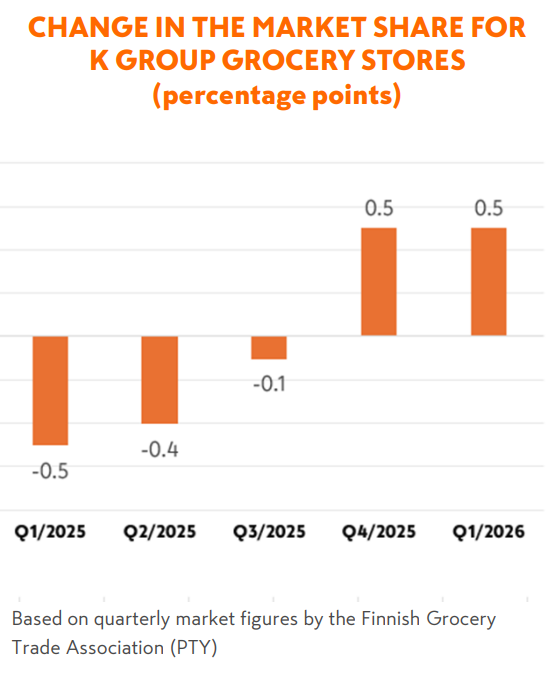
The market share for K Group grocery stores grew by 0.5 percentage points year-on-year in the first quarter of 2026 (source: Finnish Grocery Trade Association, PTY). After negative development in 2022-2024, K Group’s market share took a positive turn last summer, and between October and March we gained market share every month. The K-Citymarket chain gained market share in the hypermarket segment throughout last year. In Q4/2025 and Q1/2026, our other two grocery chains – K-Market and K-Supermarket – also gained market share in their respective segments (in year-on-year comparison). The total grocery market in Finland grew by 2.9% in Q1, while K Group’s grocery sales grew by 4.4%.
Strengthening market share was one of the main objectives set for Kesko’s grocery trade division when the Group strategy was updated in spring 2024. However, it was equally important to maintain good profitability despite efforts to boost market share, and the division’s operating margin target was set at “clearly above 6%”. In the first quarter of 2026, the division’s operating margin was strong at 6.5% (rolling 12 months) despite the market share gains achieved.
Investments in quality, prices and store network development contributing to market share growth
The positive development in market share can be attributed to the long-term strategic investments made in the price and quality levels of the stores as well as the development of the grocery store network.
Prices: The Finnish grocery trade market has been very price-driven in recent years, and price continues to be an important consideration for many customers. In January 2025, Kesko and K-retailers launched an extensive long-term price programme, cutting prices on more than 1,200 popular everyday staples in K Group grocery stores. Combined, Kesko and the retailers invested €50 million in the programme last year. In addition to the price programme, we have actively invested in campaigns as well as in targeted personal offers and benefits. The efforts have paid off, as customer flows in K Group grocery stores have grown. Average purchase is also up, and customers are not buying only the discounted products, but increasingly do their main weekly shop at our stores.
Quality: Raising the quality level of K Group grocery stores further involves a wide range of actions aiming to ensure suitable selections, good product availability, excellent customer service, reliable and useful digital services, and high quality products. In the current strategy period, special attention has been paid to certain key product categories, such as bread and fruit and vegetables. The implementation of store-specific business ideas, tailored to local demand and customer base, plays a crucial role in developing better stores. The business ideas can be implemented even more effectively with the help of new tools that utilise data and AI for easier selection and campaign management, thus freeing up store staff for more personal customer service.
Efforts to improve quality have paid off, as customer satisfaction grew clearly in all three K Group grocery chains in both Q4/2025 and Q1/2026. Demand for valuable and premium product categories, such as service counter items, fruit and vegetables and high-quality ready meals, has also grown.

New premium flower departments and the development of popular K-Ruoka digital services are examples of investments made in customer service and quality.
Store network: Having the right-sized stores situated in the right locations supports positive market share development. Kesko invests €200-250 million annually in the development of its grocery store network. In 2025, we opened 60 new or remodelled stores, including 2 new K-Citymarket hypermarkets. In 2026, we will open 25 new stores and remodel more than 60. Network development covers stores of all sizes, although growth in Finnish grocery trade in recent years has been the strongest in larger stores sizes, such as hypermarkets. In new store openings, our focus is especially on urban growth centres. Meanwhile, store remodelling often involves aspects such as updating refrigeration equipment to meet the requirements of tightening EU regulations.
Network development can also involve closing stores, which can have a negative market share impact in the short term. For example, the discontinuation of the Neste K chain in 2024 reduced the number of our stores by over 60. All together, network changes made by both K Group and its competitors had a negative impact on K Group’s market share in 2025, while in 2026, the impact is expected to be neutral. Network development efforts should gradually support our market share development in upcoming years.
President and CEO Rauhala: Strong sales and profit in all Kesko divisions in Q1
"In the first quarter of 2026, Kesko’s profit improved and net sales grew in all divisions. Kesko’s Q1 net sales totalled €3,029 million. Net sales grew by 4.6% in comparable terms year-on-year. Kesko’s comparable operating profit amounted to €102 million, and grew by €6.5 million. Cash flow from operating activities grew markedly stronger thanks, in particular, to good working capital management. All three divisions showed positive development even though the market remained relatively challenging. The crisis in the Middle East does not have a significant impact on Kesko’s operations in the short term, but a prolonged situation could result in weakened consumer confidence, purchasing power and corporate investments as well as higher costs.
In the grocery trade division, our long-term strategic efforts focused on quality, price, and the store site network yielded results. For the first time since the pandemic, the division saw growth on all three fronts: net sales, profit, and market share. Net sales for the division grew by €72 million and totalled €1,558 million. The comparable operating profit for the division totalled €78.4 million, up by €5.5 million. The market share for K Group grocery stores took an upturn in the summer of 2025, and the positive trend has continued in 2026: our grocery store chains all won over market share in Q1 in their respective size segments. K Group grocery sales grew by 4.4% against a total market growth of 2.9%. Customer flows and average purchase also grew. Although price plays a significant role in the grocery trade market, demand for quality products and services has increased. Net sales for the foodservice business decreased by 0.6%, but Kespro continued to gain market share.
In the building and technical trade division, net sales grew by €114 million and totalled €1,147 million. The division’s comparable operating profit amounted to €14.5 million, up by €2.8 million. Net sales for building and home improvement trade increased by 16.9% underpinned by acquisitions, or by 3.3% in comparable terms. K-Rauta’s comparable operating profit in Finland decreased slightly, but remained at a good level. In technical trade, comparable operating result improved in all operating countries, and net sales grew. In Finland, Onninen gained market share markedly in the first quarter. Gradual recovery in the construction cycle has continued in all our operating countries.
In the car trade division, net sales totalled €331 million. Net sales grew by €17 million year-on-year, driven in particular by used car sales. The comparable operating profit totalled €16.1 million, down by €1.8 million. The division gained market share in both new and used cars, and service sales increased. The order book for new cars grew due, in particular, to interesting new models. In sports trade, sales and profit grew and market share improved.
We repeat our profit guidance and estimate that the comparable operating profit for 2026 will amount to €650–750 million. We estimate that the operating environment, net sales and profit will improve in all divisions and all operating countries in 2026.
KEY FIGURES IN JANUARY-MARCH 2026:
-
Group net sales in January-March totalled €3,029.0 million (€2,827.7 million); reported net sales grew by 7.1% while in comparable terms, net sales grew by 4.6%
-
Comparable operating profit totalled €102.0 million (€95.6 million), representing an increase of €6.5 million
-
Operating profit totalled €96.6 million (€89.4 million)
-
Cash flow from operating activities totalled €77.7 million (€-24.5 million)
-
Comparable earnings per share €0.14 (€0.13); reported earnings per share €0.13 (€0.12)
> See the Q1/2026 interim report and presentation materials
Recap of Kesko's key events in Q1/2026
Kesko will publish its first-quarter results for 2026 on Wednesday, 29 April 2026, at around 8.00 am Finnish time. An English-language audiocast/teleconference for investors and analysts will be held at 9.00 am Finnish time.
Below is a recap of key events and materials for the quarter from an investor perspective.
NEWS, FINANCIALS AND SHARES
-
Kesko’s Annual General Meeting of shareholders was held on 26 March 2026. The Meeting resolved, among other things, to distribute a dividend of €0.90/share for 2025, and elected 7 members to Kesko’s Board of Directors for a one-year term of office, including Mervi Airaksinen as a new member. (release)
At its organisational meeting, the Board of Directors re-elected Esa Kiiskinen as its Chair. (release)
-
Kesko’s Annual Report for 2025 was published in February. The report comprises a general review of the company’s strategy, businesses and key sustainability efforts and targets, a Corporate Governance Statement and Remuneration Report, as well as the financial statements section, which includes a sustainability statement. (release)
-
Jan-Erik Fredriksson was appointed as Kesko’s new Chief Information Officer (CIO). He comes to Kesko from Fortum, and will assume his position in August 2026 at the latest. (release)
-
Shares:
-
Presentation for Kesko’s Q1 investor roadshow meetings. (presentation)
SALES DEVELOPMENT
Sales figures for March will be released in mid-April.
GROCERY TRADE
-
Efforts to turn around market share development yielded results towards the end of 2025. K Group grocery stores managed to increase their market share by 0.5 percentage points in the final quarter of 2025, and by 0.2 percentage points in July-December 2025. In the hypermarket segment, Kesko’s K-Citymarket chain gained market share throughout last year. In Q4, K Group grocery stores won over market share in all store size segments. The positive development can be attributed to Kesko’s strategic investments in the store network as well as in the quality and price levels of the grocery stores. (release)
In total, Kesko’s grocery trade market share in 2025 amounted to 33.5% according to the Nielsen IQ Grocery Shop Directory. (release)
SUSTAINABILITY
-
SBTi validated Kesko’s new science-based emission reduction targets. The Science Based Targets initiative (SBTi) has validated Kesko’s new near term and long term science-based emission reduction targets, extending to 2034 and 2050, respectively. Kesko is set to reduce emissions from its own operations through, for example, increased use of electric transportation and improved energy efficiency. Emissions from products sold will be reduced in close cooperation with suppliers. (release)
-
Kesko ranks highest in its sector in both the European and global listings of the most sustainable companies. The Canadian media and research organisation Corporate Knights publishes annual listings of the most sustainable companies in the world and in Europe. Kesko ranked the highest of all companies in its sector in both listings this year. Kesko is the only company in the world to have been included in the global sustainability listing every year since it was first launched in 2005. (Europe 50 release, Global 100 release)
President and CEO Rauhala: Kesko's result improved and net sales increased in all divisions in 2025
"Kesko’s comparable operating profit improved and net sales increased in all three divisions in 2025. The full-year net sales amounted to €12,474.1 million and comparable operating profit to €654.9 million. In the latter half of the year, there was a turnaround in profit, as quarter-result improved in Q3 and growth continued in Q4. The successful execution of our updated growth strategy in all divisions has yielded results even in an operating environment that has continued to be challenging. Our cost control has also been effective. Our good ability to generate profit and financial position have enabled investments in growth, and we will continue strong growth investments also in upcoming years. Kesko’s Board of Directors proposes to the Annual General Meeting a dividend payment in line with the company’s dividend policy: €0.90 per share, or over €358 million in total, to be paid in four instalments.
Kesko’s Board proposes a dividend payment of €0.90 per share, over €358 million in total, in line with the company's dividend policy
Net sales for Kesko’s grocery trade division grew and totalled €6,447.7 million in 2025, with a comparable operating profit of €418.1 million.
Kesko’s objective in grocery trade is to strengthen its market position while maintaining good profitability. Both were achieved in 2025. Operating margin for the division stood at 6.5%. The market share development for K Group grocery stores was very close to the market trend for full-year 2025. A significant turn was seen in the summer, and our market share grew by 0.2 percentage points in July-December and by 0.5 percentage points in Q4 (source: Finnish Grocery Trade Association). The K-Citymarket chain gained market share in the hypermarket segment throughout 2025, and in the final quarter, all K Group grocery chains won over market share in their respective segments. Kesko’s strategic investments in the grocery store network and the price and quality levels of the stores are yielding results. The total grocery trade market also grew from the summer onwards. In the foodservice business, Kespro gained market share despite the 0.3% decrease in sales.
In the building and technical trade division, both net sales and comparable operating profit grew despite the weak cycle in new housing construction. Net sales for the division totalled €4,685.8 million, with a comparable operating profit of €178.6 million. The full-year 2025 profit improved in building and home improvement trade and was close to flat in technical trade, while in the final quarter, profit improved in both business areas. We strengthened market position for Davidsen in Denmark by acquiring three local building and home improvement trade operators in 2025: Roslev, Tømmergaarden and CF Petersen & Søn. Kesko’s biggest ever construction project, the joint Onninen and K-Auto logistics centre Onnela in Hyvinkää, Finland, was completed in 2025. Gradual recovery in the construction cycle continued throughout the year, but the pace of recovery in the latter half of the year was weaker than anticipated, especially in new housing construction. In the longer term, however, outlook for the building and technical trade division is positive. Strategic focus for the division is on securing growth and profitability and improving cash flow in each country and business.
Net sales for the car trade division in 2025 increased by 12% and totalled €1,364.8 million, with a comparable operating profit of €83.1 million. The division managed to improve its net sales and comparable operating profit significantly despite the fact that the car trade market in Finland continued to be challenging, as consumer confidence stayed weak and uncertainty regarding powertrain choices persisted. Net sales grew in new and used cars, car services, and sports trade. The strong product and service portfolio and significant transformation measures carried out within the division in recent years have resulted in improved sales and profitability. Kesko’s objective in car trade is to outperform the market in all business areas.
Our market position grew stronger in nearly all business areas in 2025. We estimate that both our operating environment and results will improve in 2026 in all divisions and operating countries. I want to thank all our customers, the people of K Group, our shareholders, and our partners for their trust and cooperation in 2025.
KEY FIGURES IN OCTOBER-DECEMBER 2025:
-
Group net sales in October-December totalled €3,230.9 million (€3,040.6 million); reported net sales grew by 6.3% while comparable net sales grew by 3.1%
-
Comparable operating profit totalled €174.6 million (€170.8 million), representing an increase of €3.8 million
-
Operating profit totalled €160.1 million (€121.0 million)
-
Cash flow from operating activities totalled €292.5 million (€301.0 million)
-
Comparable earnings per share €0.28 (€0.31); reported earnings per share €0.25 (€0.19)
KEY FIGURES IN JANUARY-DECEMBER 2025:
-
Group net sales in January–December totalled €12,474.7 million (€11,920.1 million); reported net sales grew by 4.7%, while comparable net sales grew by 2.3%
-
Comparable operating profit totalled €654.9 million (€650.1 million), representing an increase of €4.8 million
-
Operating profit totalled €631.3 million (€579.5 million)
-
Cash flow from operating activities totalled €879.7 million (€1,008.2 million)
-
Comparable earnings per share €1.07 (€1.11); reported earnings per share €1.02 (€0.95)
> See the full 2025 financial statements release and presentation materials