Reusable containers for takeaway food – unique trial under way in the Helsinki region
Reusable containers for takeaway food – unique trial under way in the Helsinki region
07.04.2026
During the spring, Kesko, S Group and nine other companies are jointly testing reusable takeaway containers with a deposit and related return system. During the pilot, customers at four stores can choose a reusable container for takeaway food instead of a single-use one. The Kiertis pilot is linked to the EU Packaging and Packaging Waste Regulation (PPWR), and one of the aims of this is to promote the reuse of packaging.
The unique joint Kiertis pilot will examine how the circulation of reusable takeaway containers with a deposit works in practice. The pilot will assess whether reusable takeaway food containers appeal to customers, whether the return system is cost-efficient, and what kind of environmental impacts the system has. The pilot is being carried out as part of the Reusify project, which is funded by Business Finland and led by VTT Technical Research Centre of Finland and the University of Vaasa, and which involves companies and research organisations.
During the pilot, experiences will be gathered particularly on the functionality of the return and washing system. The aim is to understand what the reuse of containers means in daily life for both customers and store employees, for example in terms of workflow and hygiene requirements.
“Many companies are involved in the return system. A deposit-based model only works if the different parties in the chain cooperate seamlessly. In the pilot, we are looking for solutions that are practical in everyday store operations, easy for customers and financially sustainable,” says Iida Lehtimäki, Sustainability Specialist at SOK.
The success of the pilot depends on the willingness of customers to try a new way of operating, which is why the trial continuously monitors how reuse works from their perspective. At the same time, the pilot will show how reusable containers are received and what kind of solutions feel natural to customers.
Each returned container provides valuable information on the system
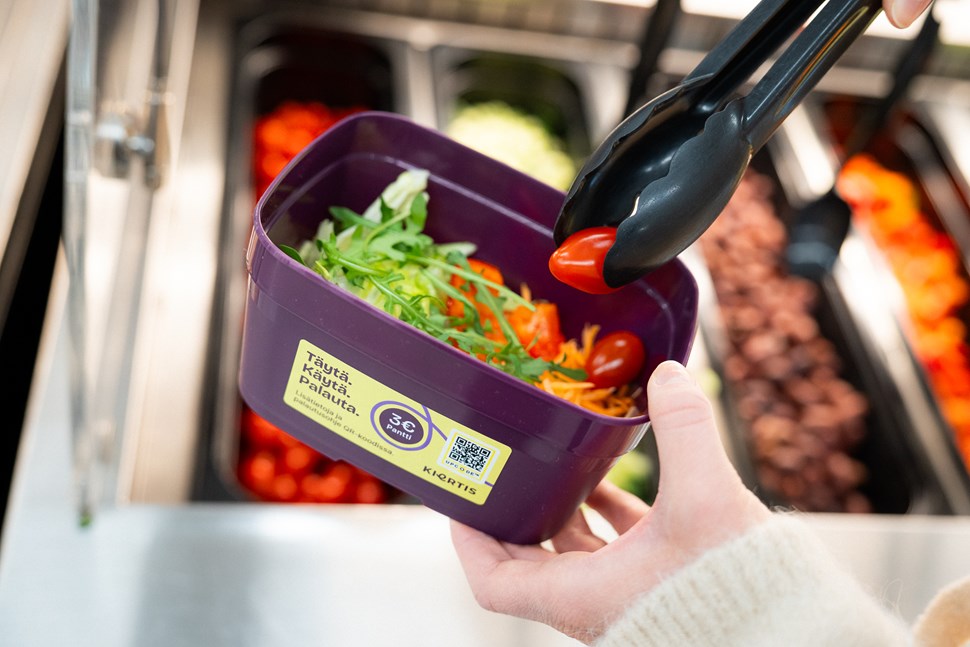
The deposit for one container is three euros, and its purpose is to encourage customers to return the containers rather than, for example, keep them for home use. The deposit is refunded when the container is returned, so choosing a reusable takeaway container is ultimately free of charge for the customer.
For the testing to succeed, we hope that all containers – including damaged ones – are returned for reuse. This will give us information for developing the system and, for example, on how many times a single container can be reused,” says Hannele Dahl-Nevalainen, Development Manager at Kesko.
“The functionality of the return system will be monitored throughout the pilot so that we can respond, for example, to the speed of the washing cycle and the availability of containers in stores,” Lehtimäki adds.
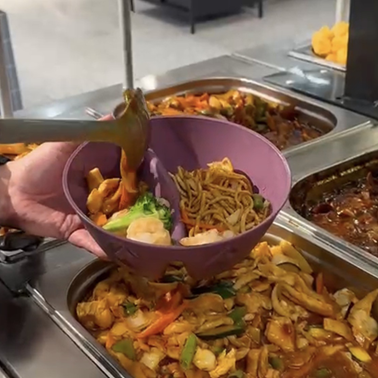
The dark purple container is made of bio-based polypropylene plastic, which is also used in similar food storage containers. It is designed to withstand use and multiple washing cycles. The condition and hygiene of the boxes are monitored at different stages of the return system, and damaged boxes are removed from circulation.
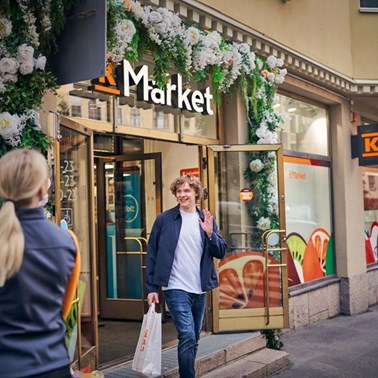
During the pilot, the reusable takeaway container option will be available in four grocery stores in Espoo: at the Ruokatori service counters of Prisma Lippulaiva and Prisma Sello and at the salad bars of K-Citymarket Sello and K-Supermarket Lippulaiva. Containers can be returned to Kiertis return machines located in the Lippulaiva and Sello shopping centres near to the bottle collection machines.
Target to reduce packaging waste and increase reuse
The PPWR Regulation, which entered into force in February 2025, requires a reduction in packaging waste and an increase in both recycling and reuse. The regulation requires that by 2030 at least one fifth of takeaway food must be sold in reusable packaging. Achieving these targets requires new circular economy solutions, and the Kiertis pilot, which is testing deposit-based packaging, is one way to respond to these requirements.
“The end result of the pilot will not yet be a system ready for implementation, but rather a better understanding of what a possible operating model would require and whether it would be viable from different perspectives. One reusable takeaway container is estimated to replace dozens of single-use containers. This reduces waste and saves natural resources, so we hope the pilot will provide lessons for developing possible permanent systems,” says Dahl-Nevalainen.
The pilot began in early March, and containers will be available in pilot stores until the end of May, but they can be returned until 28 June.
The companies involved in the Kiertis pilot are: Kesko, K-Supermarket Lippulaiva, K-Citymarket Sello, SOK, HOK-Elanto, Prisma Lippulaiva, Prisma Sello, Finnish packaging and Recycling RINKI Ltd, KiiltoClean Oy, Lassila & Tikanoja, Oy Orthex Finland Ab, UPM Raflatac Oy, Upcode, Compass Group, Borealis Gmbh and Transbox Oy. The Kiertis website (in Finnish): https://www.rinki.fi/kiertis/

 YES
YES
 NO
NO