
Business models
Kesko's business model
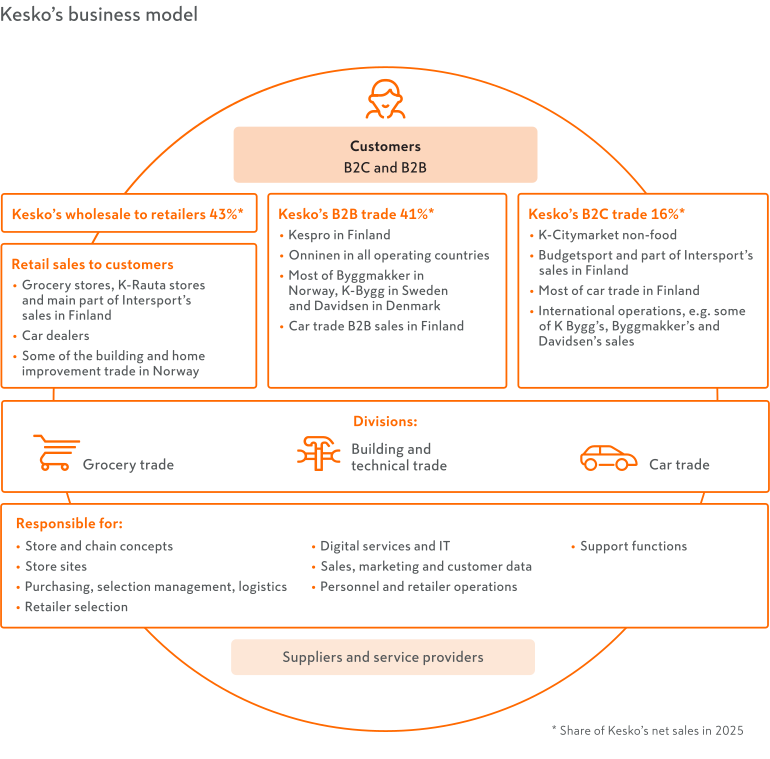
Kesko’s business model comprises Kesko’s own retailing and B2B trade, and the chain business model.
In Finland, the biggest business model is the chain business model, in which K-retailers run retail stores in Kesko’s chains, namely the grocery store chains, and the K-Rauta and Intersport chains. Some 43% of Kesko’s net sales come from sales to retailers.
Kesko’s own retailing and B2B trade account for some 57% of net sales. In Finland, Kesko’s own retailing and B2B trade comprise e.g. car trade, Kespro, Onninen, non-food sales at K-Citymarket hypermarkets, and part of the Intersport sales and Budget Sport. B2B trade in particular is a strongly growing part of Kesko’s business. Outside Finland, Kesko mainly engages in own retailing and B2B trade.
Net sales from international operations totalled some €2.7 billion, or 22%, of Kesko’s net sales in 2025. Kesko operates in eight countries: Finland, Sweden, Norway, Denmark, Poland, Estonia, Latvia and Lithuania.
The constant improvement of customer experiences and further development of digital services are at the heart of our growth strategy. We use quality and customer experience to differentiate ourselves from the competition in both our stores and digital services.
K-retailer operations in Finland
K Group in Finland operates primarily under the chain business model, in which K-retailers engage in retail trade in Kesko’s store chains, which include the three grocery store chains and the K-Rauta and Intersport chains. In total, there are 1,015 K Group retailers in Finland (as of 1 Jan. 2026): 858 grocery retailers, 104 building and home improvement retailers, and 53 sports retailers. Outside Finland, Kesko mainly engages in its own retailing and B2B trade.
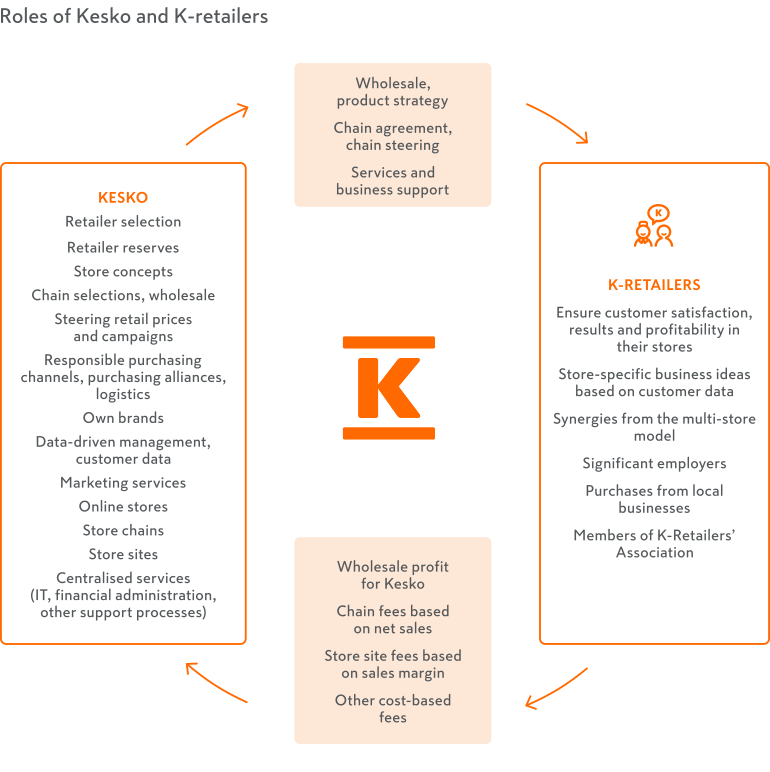
The cooperation between Kesko and the K-retailers, i.e. the chain business model, is based on equality and a desire to develop operations together, with the aim of improving competitiveness and customer satisfaction while ensuring high quality and lower costs. The respective rights and duties of Kesko and the K-retailers are determined in a chain agreement. The combination of systematic chain operations and K-retailer entrepreneurship under a shared K brand lends K Group a competitive advantage.
Kesko is responsible for the continuous development of the operating model and store concepts, for choosing retailers to run the stores, for steering chain operations, and for purchasing products included in the chain selections. Kesko provides the retailers with a retail price service that suggests a recommended or maximum price for nearly all store products. The service can be adjusted to store-specific business ideas, and the retailer may choose to set prices below the recommended or maximum price. Kesko is also responsible for the store site network and for obtaining new store sites. Kesko either owns or leases the store sites and is responsible for developing them. Kesko engages in long-term cooperation with various partners such as suppliers and logistics operators. International purchasing alliances alongside private labels such as Pirkka and K-Menu play a significant role in ensuring that the selections offered to customers are versatile and competitively priced.
K-retailers, in turn, are responsible for their stores’ business operations, store-specific business ideas, customer satisfaction, store personnel, and sales and profit. Each retailer establishes their own store-specific business idea based on customer insight and K Group customer data, in order to be able to offer the best services and selections for their customer base. K Group has a multi-store model, in which one retailer can operate multiple stores. This enables synergies in e.g. store management, personnel resourcing, and product selections. Each K Group store is part of its larger community and society, and the retailer entrepreneurs collaborate with various stakeholders.
K-retailers typically have a university or college degree, or education in business. The personality, values and attitudes of a retailer candidate are also important. The first step towards becoming a retailer is a year-long trainee programme, which consists of practical training under the guidance of a retailer mentor, online studies, and on-the-job learning and in-store training. After completing the programme, the trainees are ready to start their career as K-retailer entrepreneurs. Kesko aims to offer each candidate who has finished the training a store that is the best fit for all parties. In 2025, 58 new K-retailers launched their careers.
All K-retailers are members of K-Retailers’ Association, which promotes their shared interests and develops K-retailer operations. The association coordinates the commercial collaboration between the retailers and Kesko, and offers its members e.g. legal advice, training and events. Kesko and K-retailers work closely together to achieve shared goals. K-retailers elect from amongst themselves some 50 representatives to represent the retailers of a specific area, chain, or division in the governing bodies of K-Retailers’ Association.
K-Retailers’ Association with its related parties is the biggest shareholder in Kesko, and controls 7.72% of the shares and 20.01% of the votes in the company (31 Dec. 2025). Many individual K-retailers are also significant Kesko shareholders.
Read more in Kesko's Annual Report


