
TRACE YOUR PRODUCTS
K Group is constantly striving to improve the transparency of its purchasing chains. On this website, our customers can find out more about where the products they purchase from K Group stores come from.
K Group is constantly striving to improve the transparency of its purchasing chains. On this website, our customers can find out more about where the products they purchase from K Group stores come from.

Where do mywear t-shirts, Pirkka and K-Menu tuna products, Pirkka Fairtrade roses, and PROF Timber sold in our stores come from? We want to increase the transparency of our purchasing chains by providing information on the origin of our products and their journey to our stores. Choose a product to find out more.

Bananas are a long-standing favourite among Finns and one of the best-selling fruits in K Group grocery stores. By choosing an organic Pirkka Fairtrade banana, you can make a responsible purchase decision.
More
The men’s Cole T-shirt made of GOTS certified organic cotton is the most popular product in K-Citymarkets’ own mywear selection.
More
Tuna is one of the most popular fish species and easy to cook. All our own brand Pirkka and K-Menu tuna has been sustainably caught.
More
Finland sells the most Fairtrade flowers per capita in the world. Fairtrade premiums have a significant positive local impact on local communities in Kenya.
More
The PEFC label on the timber sold at K-Rauta building and home improvement stores indicates its sustainable origin and shows that the timber comes from certified, sustainably managed forests.
More
Is it ok to add pineapple into a pizza? This question really has divided opinion. Anyhow, canned pineapple is a favourite of the Finns. Take a look at the supply chain of Pirkka and K-Menu canned pineapple in more detail.
More
K Group’s purchasing of seafood is guided by our fish and shellfish policy, which is based on WWF's seafood guide. All Pirkka and K-Menu branded canned tuna comes from sustainable fish stocks.
Read more
The blue, oval-shape MSC label indicates that the seafood comes from a fishery that has been independently certified to the MSC’s environmental standard for fishing. All canned tuna in the Pirkka and K-Menu range is MSC-certified.
Read moreWe use third-party auditing to assure social responsibility in the factories of our tuna suppliers. The auditing monitors working conditions in factories, including workplace safety, salaries, working hours and compliance with the ban on child and forced labour, among other aspects.
K Group’s Quality and Product Development Unit's laboratory monitors the safety and quality of own brand products and own imports in the grocery trade. We require that all manufacturers have valid GFSI-recognised certifications that assure product safety.

We ensure the safety of our own brand food products. Pirkka and K-Menu cans do not contain detrimental elements such as Bisphenol. Pirkka tuna in oil and water, without added flavourings, are also available in convenient carton packs. The carton packaging is lightweight to carry and transport, easy to open without tools, and simple to recycle with other cartons after use.
Kesko follows the recommendations of WWF Finland’s Seafood Guide. Our selections do not include species rated red in the WWF Finland Seafood Guide’s traffic light system unless the products are certified according to the MSC or ASC standards. All Pirkka and K-Menu canned tuna products are made from skipjack tuna.


Skipjack tuna
(Katsuwonus pelamis)
Skipjack tuna is a small fish and the most commonly used species for canned tuna. It is related to tuna, but not one of the true tunas, or thunnus. The species lives mainly in tropical areas of the Atlantic, Indian and Pacific Oceans. Skipjack tuna stocks are healthy and it is considered a “least concern” species.
All tuna for our canned own brand Pirkka and K-Menu products comes from either Mauritius, Thailand, Spain, Portugal or Ecuador. Our suppliers process the canned tuna in factories in their countries. The tuna cans are driven in a truck to the harbour. They then travel in a container ship to the Netherlands, on a smaller ship to Helsinki in Finland, and finally on a truck to K Group’s central warehouse in Vantaa.
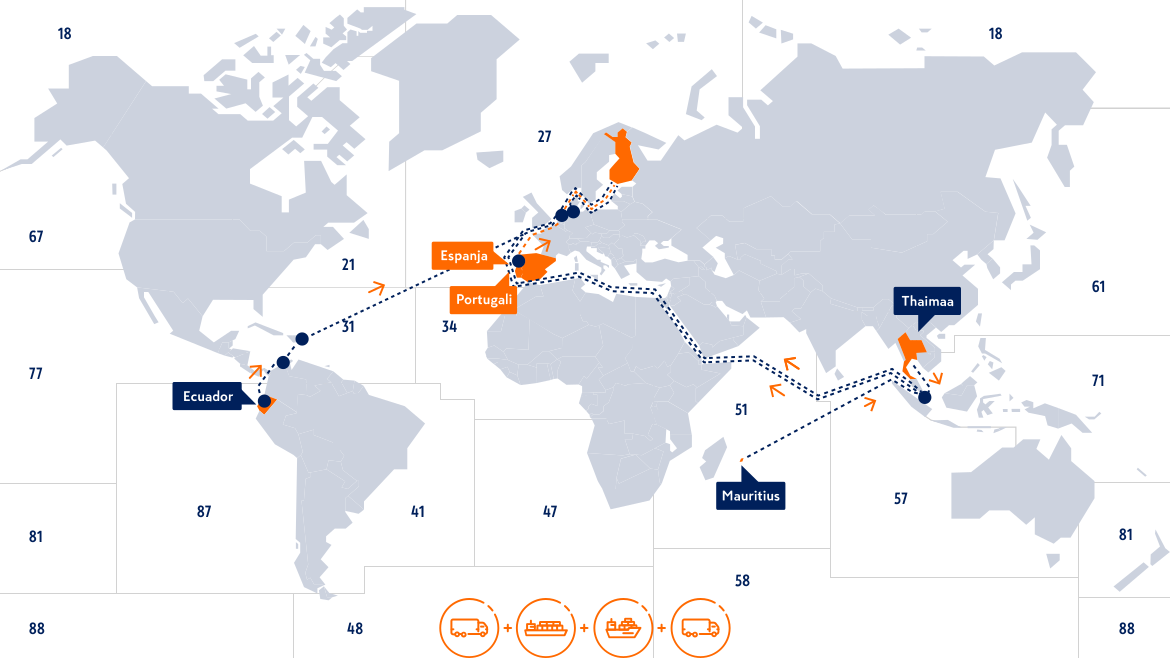
The Food and Agriculture Organization (FAO) of the United Nations has established 27 fishing areas based on statistical data-gathering, the management of fisheries, and jurisdictional purposes. The boundaries of the areas were determined on various considerations, consulting international fishery agencies. The FAO fishing area of the product can be found on the packaging, usually next to the printed code on the lid or bottom of the package.
The sustainability of fish stocks depends on the fish species, the fishing area and the fishing method used. K Group complies with the recommendations of WWF’s Seafood Guide and only accepts fish species into its selections when the fishing methods and fishing areas used do not harm fish stocks. Tuna is caught using several different methods, whose suitability varies depending on the tuna species, the depth at which the fish are found, the scale of the fishing operation and the fishing area. The MSC certification process assesses the fishing method used and its impacts on the marine environment. MSC-certified products come from well-managed fisheries that seek to minimise their impacts on the marine environment and safeguard the long-term viability of fish stocks. The fishing methods used for Pirkka and K-Menu canned tuna are pole and line and purse seine fishing.
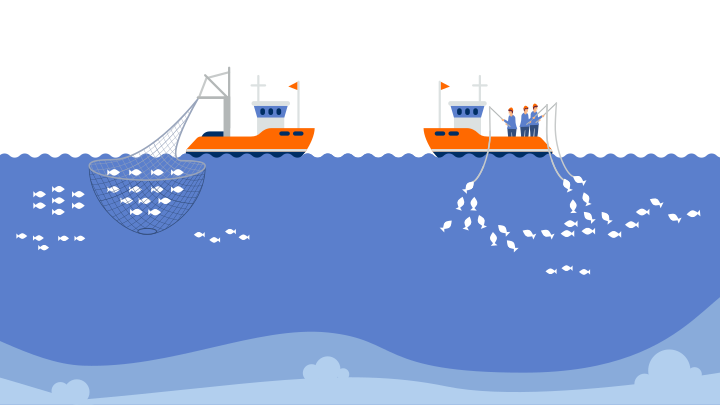
Purse seine is an efficient method of fishing on open water. It does not damage the seabed and results in low levels of bycatch. The fishers surround a school of fish with a purse seine net, then pull the net together like a bag and bring the fish to the vessel. Fisheries using purse seine must ensure that they leave enough fish in the ocean to reproduce and that they do not threaten the survival of the fish stock.
Pole & line is a fishing method for tuna and other large pelagic species. When a school of fish is located, water is sprayed from the back of the fishing vessel and small bait fish are scattered onto the surface of the water to attract the fish. The fishing takes place at the back of the fishing vessel. The fishermen use a long wooden or fibreglass pole with a hook attached, and flick the fish onto the deck one by one. The method results in low levels of bycatch and does not hurt other sea animals, such as dolphins, shark, sea turtles or birds.
We work with our suppliers on matters related to the supply chain of fish products. Our suppliers have established partners whose fishing vessels catch the tuna.
We comply with EU rules to combat illegal, unreported and unregulated (IUU) fishing. These rules ensure that illegally caught fish is not sold on the European market.
To ensure the quality and freshness of tuna products, tuna is frozen on the fishing vessel. The vessels only return to shore when their freezers are full, helping to minimise transport trips. The tuna is then taken from the port to the fish factory, where it is defrosted and processed. The tuna is then pre-cooked, cut into flakes, chunks or fillets, and canned. The products are subjected to a special heating process that ensures they remain edible for years. Pirkka and K-Menu branded tuna products come from eight suppliers. Each can of tuna has a unique factory identification code, which indicates the factory where the tuna was processed and canned. The factory identification codes are listed below.


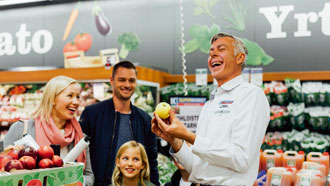
Kesko Corporation is the only company in the world to have been included on the Global 100 Most Sustainable Corporations in the World list by Corporate Knights every year since the list was first established in 2005.
Read more
Do you have questions about the origin or qualities of Pirkka products? Contact K Consumer Service by phone on 0800- 0- 1000 or via email at kuluttajapalvelu(at)kesko.fi.
Read more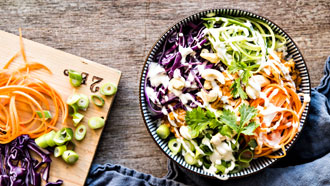
Are you looking for new tuna recipes? Plenty of recipes are available at K-ruoka.fi. Why don’t you try tuna bowl?
Read moreWould you like to learn more about another product? See here for the products:


