
TRACE YOUR PRODUCTS
K Group is constantly striving to improve the transparency of its purchasing chains. On this website, our customers can find out more about where the products they purchase from K Group stores come from.
K Group is constantly striving to improve the transparency of its purchasing chains. On this website, our customers can find out more about where the products they purchase from K Group stores come from.
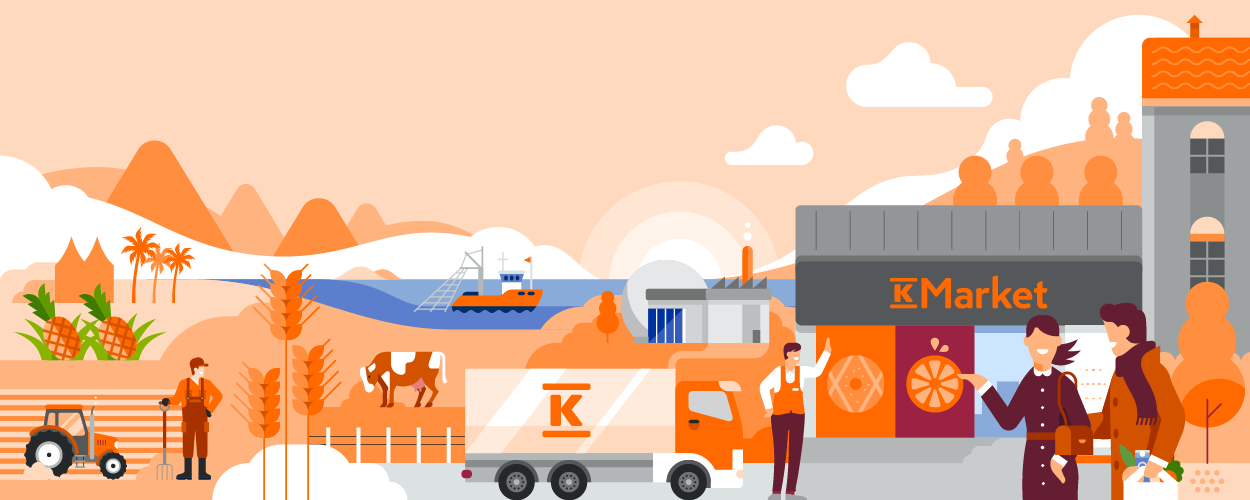
Where do mywear t-shirts, Pirkka and K-Menu tuna products, Pirkka Fairtrade roses, and PROF Timber sold in our stores come from? We want to increase the transparency of our purchasing chains by providing information on the origin of our products and their journey to our stores. Choose a product to find out more.

Bananas are a long-standing favourite among Finns and one of the best-selling fruits in K Group grocery stores. All organic Pirkka bananas are also Fairtrade certified.
More
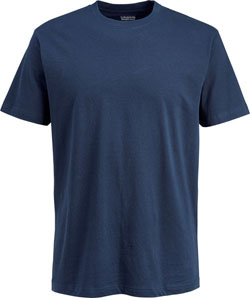
The men’s Cole T-shirt made of GOTS certified organic cotton is the most popular product in K-Citymarkets’ own mywear selection.
More
Tuna is one of the most popular fish species and easy to cook. All our own brand Pirkka and K-Menu tuna has been sustainably caught.
More
Finland sells the most Fairtrade flowers per capita in the world. Fairtrade premiums have a significant positive local impact on local communities in Kenya.
More
PROF Timber is PEFC-certified Finnish wood. Its origin is traceable, and waste is reduced in its production through packaging development and by offering products at fixed lengths.
More
Is it ok to add pineapple into a pizza? This question really has divided opinion. Anyhow, canned pineapple is a favourite of the Finns. Take a look at the supply chain of Pirkka and K-Menu canned pineapple in more detail.
More
By the end of 2027, we are committed to sourcing all cotton used in our own-brand clothing and home textiles as certified organic cotton, recycled cotton, BCI cotton or Fairtrade cotton.
Read more
Organic cotton is cotton manufactured according to the principles of organic farming. No artificial fertilisers, pesticides or genetically modified seeds are used in the farming of organic cotton.
Read more
K-Citymarkets’ own mywear selection offers outfits for women, men and children. In addition to outfits, the mywear selection includes accessories, underwear, socks, nightclothes, shoes and bags for the whole family.
Read moreCotton is the world’s most widely produced natural fibre. Around half of all textiles are made of cotton. Cotton production provides a livelihood for more than 150 million people in 75 countries. The cotton sector is an important source of income and employment, particularly in developing countries. Around 32 million farmers cultivate cotton globally, and production is largely based on smallholder farming. (Source: FAO)

Cotton production involves several risks related to environmental responsibility, social responsibility and economic responsibility. Cotton farming consumes a lot of water. If pesticides are used recklessly, they could harm the environment or endanger workers’ health. Human rights risks encountered in the production chain include the use of child labour and forced labour, overlong working hours, low pay and a lack of gender equality.
Global Organic Textile Standard (GOTS) is a leading certification system for organic textiles worldwide. GOTS certification covers the whole production chain. GOTS also includes social criteria covering the entire manufacturing chain which advance fair working conditions for those participating in production.
A product with the label grade 'organic' must contain a minimum of 95% certified organic fibres.
In line with the cotton commitment set out in Kesko’s textile guideline, by the end of 2027 we will source all cotton used in our own-brand clothing and home textiles as certified organic cotton, recycled cotton, BCI cotton or Fairtrade cotton.
Kesko is a member of the Better Cotton Initiative (BCI™). Through our BCI™ membership, we are committed to promoting improved cotton farming practices globally.
Kesko currently sources BCI cotton in accordance with the mass balance system. This means that BCI cotton cannot be physically traced to end products. Although BCI cotton is mixed with conventional cotton along the way, the total amount of BCI cotton in the supply chain remains the same.
We pay special attention to human rights and working conditions in our supply chains in countries with the greatest risk of human rights violations.
We ensure social responsibility of our suppliers’ production through third-party audits. During audits, attention is paid to the working conditions in production, including occupational safety, salaries, working hours and compliance with the ban on child and forced labour, among other aspects.


We purchase the mywear clothing sold in K-Citymarkets from Asia in cooperation with ICA in Sweden. The ICA Global Sourcing (IGS) team, which operates in Asia, is responsible for ensuring social responsibility at the factories in cooperation with Kesko. With a total of around 100 employees, IGS has offices in China, Hong Kong, Bangladesh and India.
An essential part of the cooperation is to ensure social responsibility at the suppliers’ factories as well as the safety and quality of the products. Beside third-party social responsibility audits, IGS performs its own social responsibility audits. IGS also organises social responsibility training for suppliers in Asia.
The cotton used in Mywear Cole T-shirts is BCI or organic cotton grown in India. From the factory of Gomatha International or Expoknits International in India, the T-shirts are taken by rood to Tuticor port. From there, their journey continues in a container on a large ship via Colombo in Sri Lanka to Antwerp, Belgium, and then on a smaller vessel to Vuosaari port in Helsinki and finally by truck to K Group’s central warehouse in Hakkila, Vantaa.

The ginning process of cotton includes drying, cleaning, ginning, classifying and baling. The cotton is then spun into yarn. During the spinning process, cotton lint is blown to fluffy, various bales are blended together, carded and spun into yarn. Next the yearn is knit and after comes the next stages of the manufacturing of the T-shirts: colouring, cutting, sewing and finalizing.

A lot of chemicals, such as colouring and finishing agents, are used in the textile industry. The choices made in production of what chemicals to use have an impact on the environment and people’s health. We closely monitor any changes made in legislation regarding forbidden and restricted chemicals, and we choose the use of less-harmful chemicals. At Kesko, we maintain an up-to-date list of forbidden and restricted substances which is even more strict than the EU REACH regulation itself.


K-Citymarket stores offer clothes designed to stand the test of time. Alongside our seasonal collections, our selections include basic garments that are available for a longer period and emphasise timeless style. Our seasonal clothing also take into account long-lasting usability. Affordable prices are based on our long-term cooperation with factories and large production volumes.
Non-food product waste is systematically tackled in K-Citymarket stores. In addition to prevention, waste is minimised through discount pricing, donations and outlet departments.
We provide our customers with diversified recycling services for waste and discarded items and develop innovative circular economy solutions in cooperation with other operators.
Next to many K-stores, UFF, Fida or the Salvation Army have their clothes collection points, for example. Check the location of the Rinki eco take-back point nearest to you from the Rinki website.
Kesko Corporation is the only company in the world to have been included on the Global 100 Most Sustainable Corporations in the World list by Corporate Knights every year since the list was first established in 2005.
Read more
K-Citymarkets offer you suitable clothing for everyday wear, parties and sports. We welcome you to familiarise yourself with K-Citymarket’s extensive clothing selection.
Read more
In Finnwear's new clothing collection, you will find a wide selection of easy-to-combine everyday basics and stylish outfits that embody the joy of life & practical elegance.
Read more


