
TRACE YOUR PRODUCTS
K Group is constantly striving to improve the transparency of its purchasing chains. On this website, our customers can find out more about where the products they purchase from K Group stores come from.
K Group is constantly striving to improve the transparency of its purchasing chains. On this website, our customers can find out more about where the products they purchase from K Group stores come from.

Where do mywear t-shirts, Pirkka and K-Menu tuna products, Pirkka Fairtrade roses, and PROF Timber sold in our stores come from? We want to increase the transparency of our purchasing chains by providing information on the origin of our products and their journey to our stores. Choose a product to find out more.

Bananas are a long-standing favourite among Finns and one of the best-selling fruits in K Group grocery stores. By choosing an organic Pirkka Fairtrade banana, you can make a responsible purchase decision.
More
The men’s Cole T-shirt made of GOTS certified organic cotton is the most popular product in K-Citymarkets’ own mywear selection.
More
Tuna is one of the most popular fish species and easy to cook. All our own brand Pirkka and K-Menu tuna has been sustainably caught.
More
Finland sells the most Fairtrade flowers per capita in the world. Fairtrade premiums have a significant positive local impact on local communities in Kenya.
More
The PEFC label on the timber sold at K-Rauta building and home improvement stores indicates its sustainable origin and shows that the timber comes from certified, sustainably managed forests.
More
Is it ok to add pineapple into a pizza? This question really has divided opinion. Anyhow, canned pineapple is a favourite of the Finns. Take a look at the supply chain of Pirkka and K-Menu canned pineapple in more detail.
More
Pirkka Fairtrade rose is one of the most popular Fairtrade products in Finland. Most Pirkka Fairtrade roses come from Fairtrade-certified flower farms in Kenya. Optimal climate and other conditions, timely harvesting, on-site packaging, and well-designed logistics ensure the high quality of the cut roses.

Pirkka Fairtrade roses first appeared in K-food stores in 2006. Today, K-food stores also sell Pirkka Fairtrade spray carnations and floribunda roses. Each year, K-food stores sell around 2 million Pirkka Fairtrade rose bouquets.

Farmers are paid a guaranteed price and a Fairtrade premium for the products. Fairtrade premiums have been used to build day-care centres, schools and healthcare centres for local communities, as well as housing for workers. In 2025, K-food stores paid a total of €348,300 in Fairtrade Premium to farmers for Fairtrade flowers.

Cut roses can thrive in a vase for up to three weeks if you take good care of them. Roses need plenty of water and thrive in deep water. A freshly cut absorption area – as well as clean tissue that is intact at the base of the stem – ensure unhindered access for water to the conducting tissue in the stem. Roses keep longer when they are not exposed to draughts, heat or direct sunlight.
Most Pirkka Fairtrade roses come from Kenya, where Nini, Penta Flowers and Ravine Roses are among the largest producers. Small quantities of roses are also sourced from Fairtrade-certified flower farms in Ethiopia. The big Pirkka Parhaat Fairtrade rose sold during spring comes from Ecuador.
The sunny weather in Kenya is ideal for rose farming throughout the year. Kenya’s location on the equator provides for daily sunshine, with only minor changes in temperature. Kenya also has excellent transport connections.
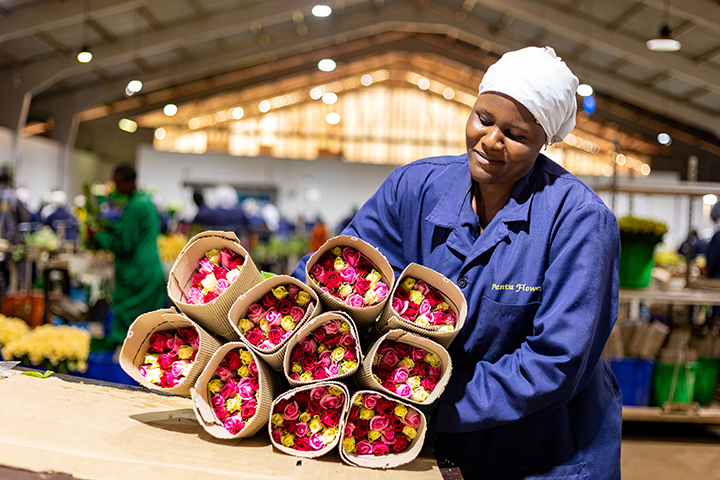
Saumu Nyadzua works at the Penta Flowers farm.
Photo: Fairtrade, Vincent Owino
Many species of roses
When choosing a rose species, attention is paid to the length of the stem, resistance to plant diseases, strength and suitability for the weather conditions in Kenya, as well as yield per square metre. Important selection criteria also include current trends, the beauty of the rose, the flower opening duration and the vase life.
Colours change by the season
The colours of the roses sold at K-food stores are chosen based on customers’ preferences and the season. Cold colours, such as pink, are favoured in the spring. Warm colours, such as orange and yellow, are popular in the autumn, while red and white are Christmas favourites.
We ensure social responsibility in our suppliers’ production with third-party audits. Attention is paid to the working conditions in factories and plantations, including occupational safety, salaries, working hours and compliance with the ban on child and forced labour.
Fairtrade audits ensure that working conditions, labour rights and the use of Fairtrade Premiums are in line with the Fairtrade criteria.
The Fairtrade criteria also include requirements related to environmental protection, aimed at promoting the sustainable use of soil and water resources, for example.
On Kenyan flower farms, environmental considerations are taken into account through practices such as reusing water and using renewable energy sources. Flower farms collect rainwater in pools for irrigation. If necessary, water can also be taken from wells, lakes and rivers.
Quality assurance
At K Group’s Quality and Product Development Unit, the laboratory monitors product safety and the quality of the company’s grocery brands and imports. In quality assurance for flowers, attention is paid to outer quality and product labelling, in addition to ensuring that the quality of the flowers remains high all the way to the consumer. During a preservation study, the preservability and shelf life of flowers are checked throughout the chain, from the packaging department in Kenya to the Finnish consumers.
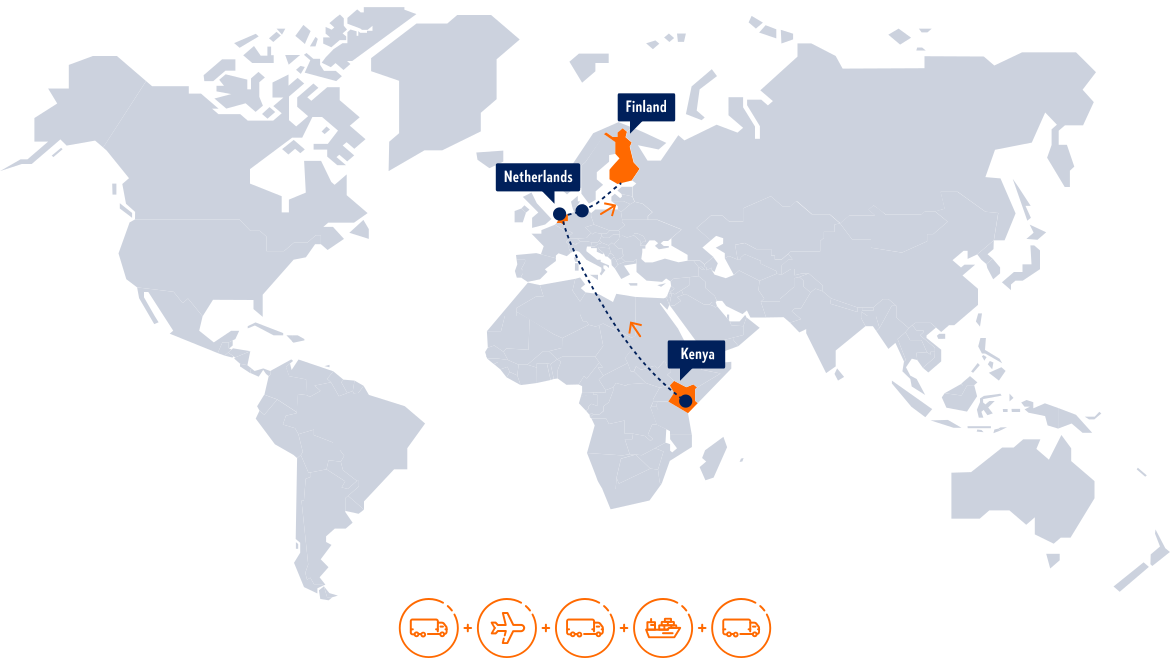
Roses are usually transported by air in temperature-controlled conditions from Kenya to the Netherlands. In the Netherlands, the protective packaging is removed from the rose bouquets, their quality is checked, the stems are recut to create fresh absorbing surfaces, and the roses are placed in buckets with water and flower food. After this, the roses are transported to Finland in a temperature-controlled truck, which is taken by ferry from Germany. Once in Finland, the roses are delivered to Kesko’s central warehouse in Vantaa, from where they are picked for deliveries to K-stores. At best, the roses arriving in Finland are available to customers in stores the following day. The transport temperature of the roses is monitored throughout the journey to ensure product quality.
In 2025, a total of €348,300 was paid in Fairtrade Premium to farmers for the Fairtrade flowers sold at K-food stores. The Fairtrade Premium is paid to farmers and workers in addition to the sales price. On flower farms, the workers are responsible for deciding how the Fairtrade Premium is used. The funds are intended for the social or economic development of the community.
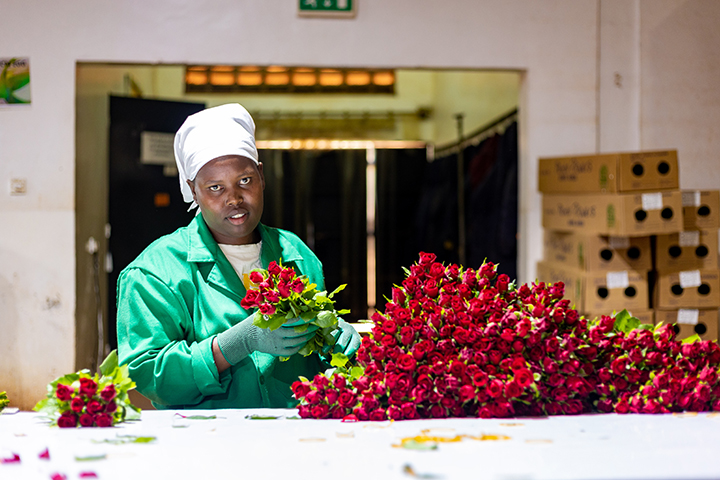
Zipporah Moraa Ombiro is sorting Fairtrade roses into bundles.
Photo: Fairtrade, Vincent Owino
Fairtrade premiums have been used for many purposes on flower farms

Pirkka Fairtrade roses come from several Fairtrade flower farms in Kenya. We present the three main flower producers below.
Kesko Corporation is the only company in the world to have been included on the Global 100 Most Sustainable Corporations in the World list by Corporate Knights every year since the list was first established in 2005.
Read more
Do you have questions about the origin or qualities of Pirkka products? Contact K Consumer Service by phone on 0800- 0- 1000 or via email at kuluttajapalvelu(at)kesko.fi.
Read more
International Fairtrade began in the 1980s. The first Fairtrade product in the Pirkka range was Pirkka Fairtrade coffee, introduced in 1999.
Read moreWould you like to learn more about another product? See here for the products:


